
Tech · Beginner to Advanced · Handwritten PDF notes
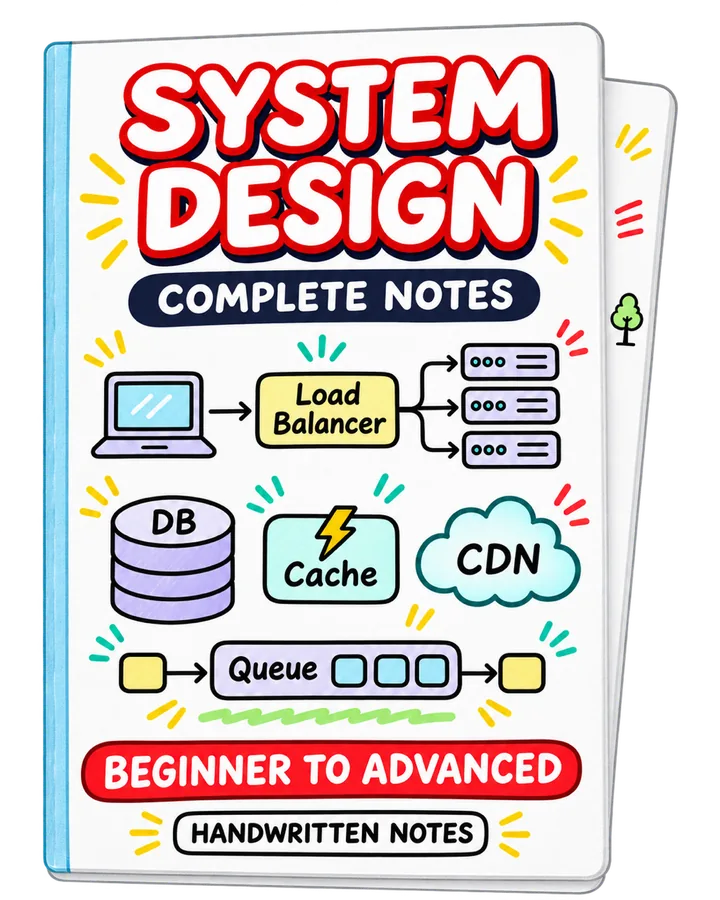
System Design Complete Notes
Instant PDF download after payment. Pay once, keep forever.
- Instant download
- Lifetime access
- UPI, GPay, PhonePe, cards
Complete coverage
What you learn in all 28 chapters
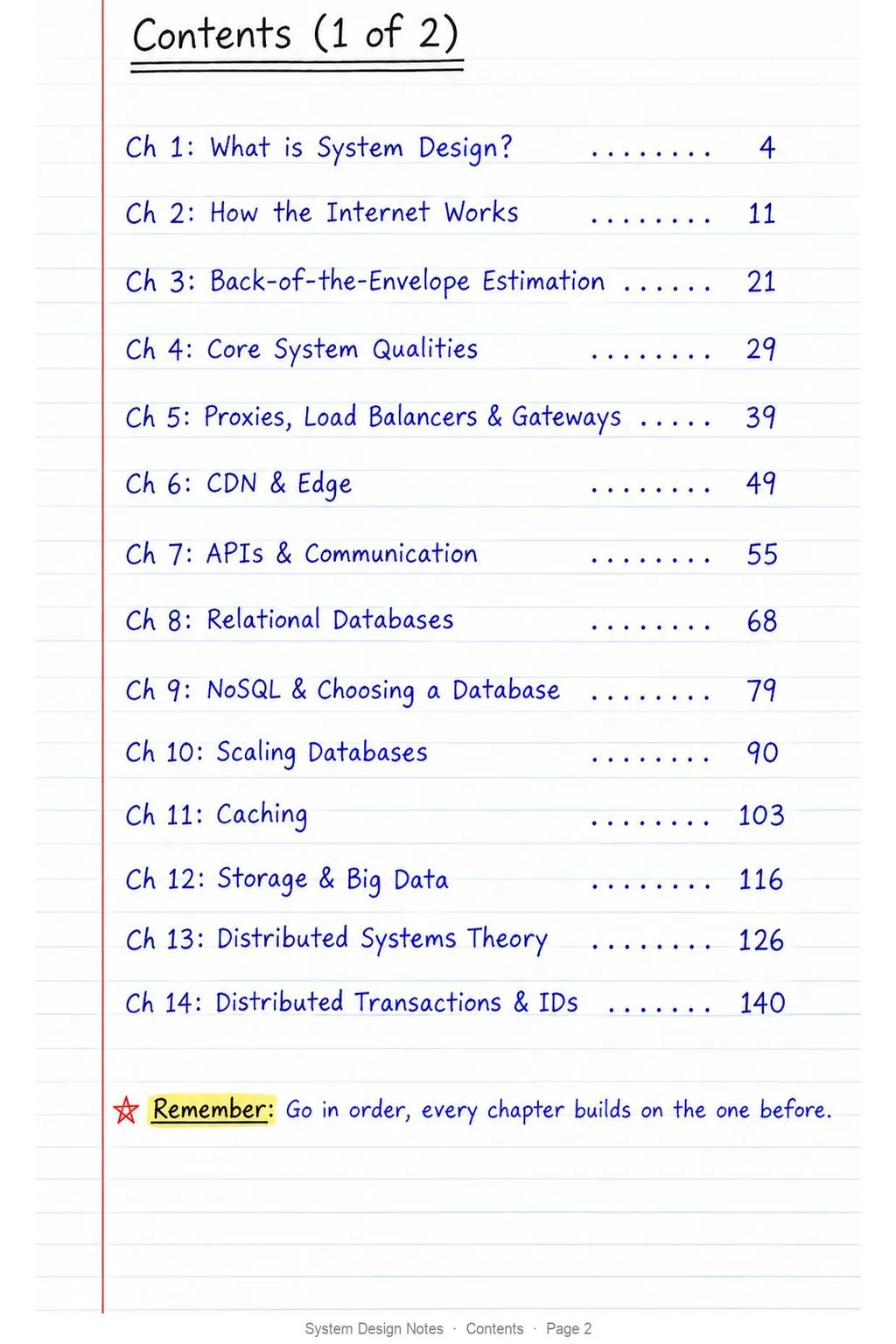
Open any chapter to see every topic it covers and the page it is on.
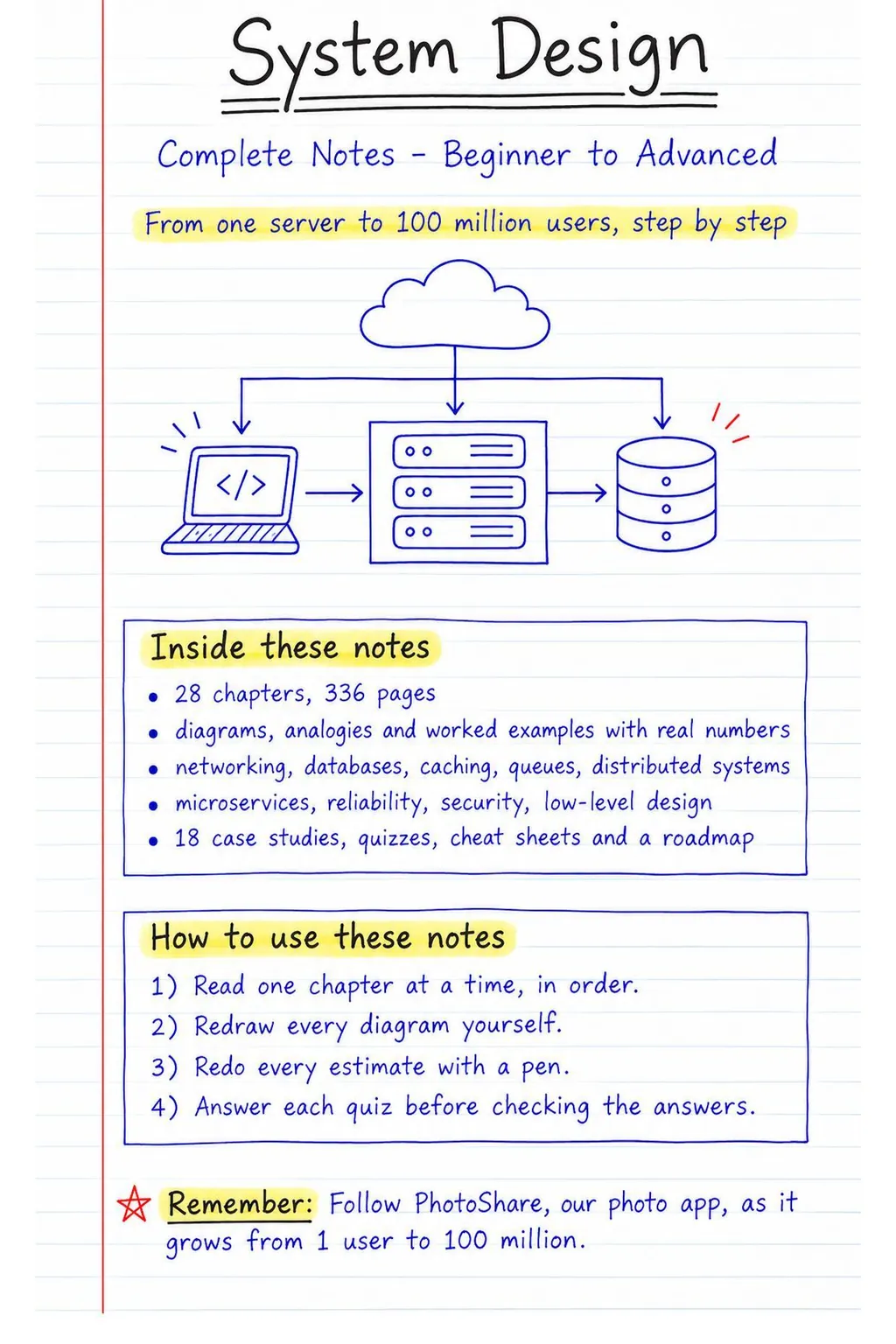
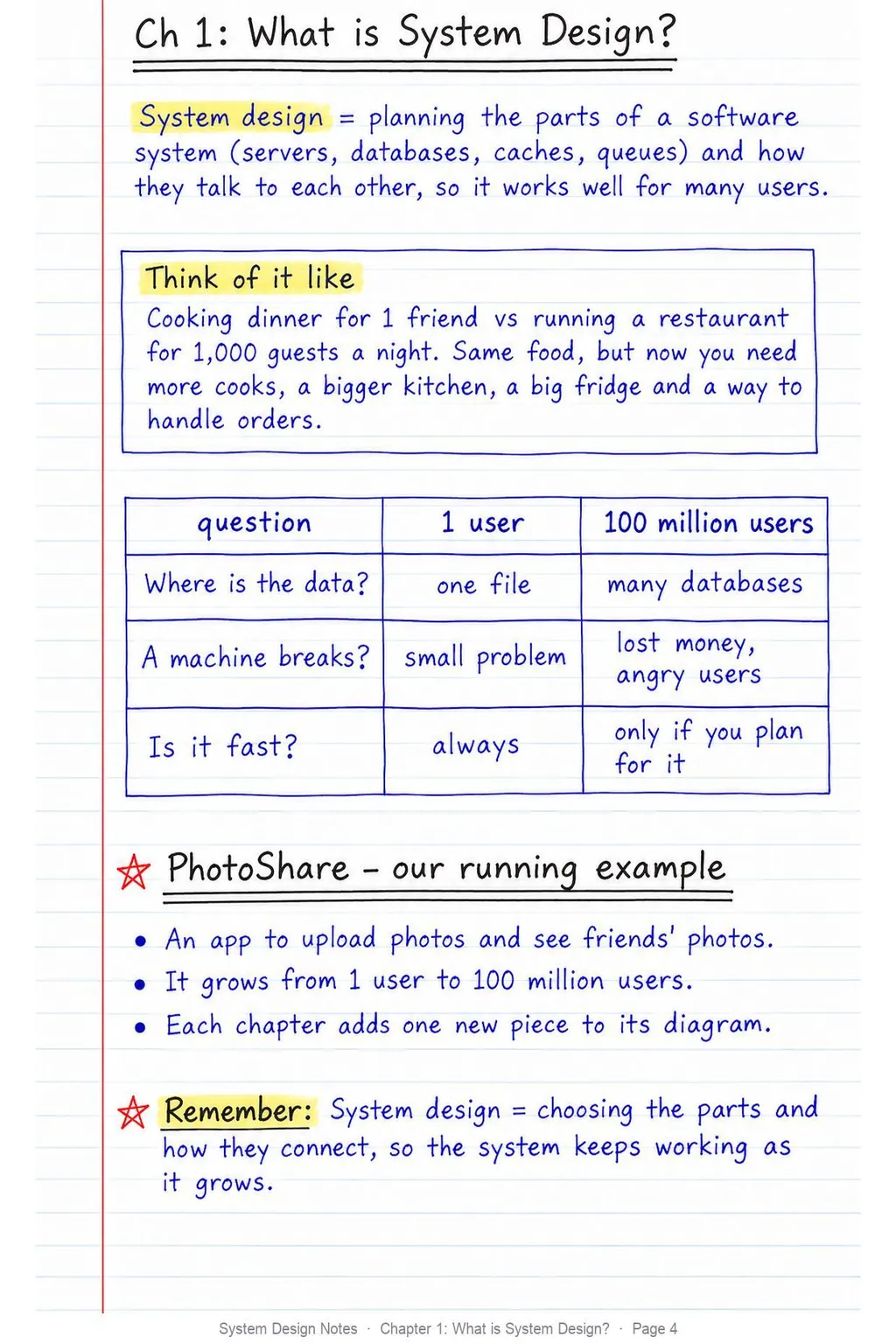
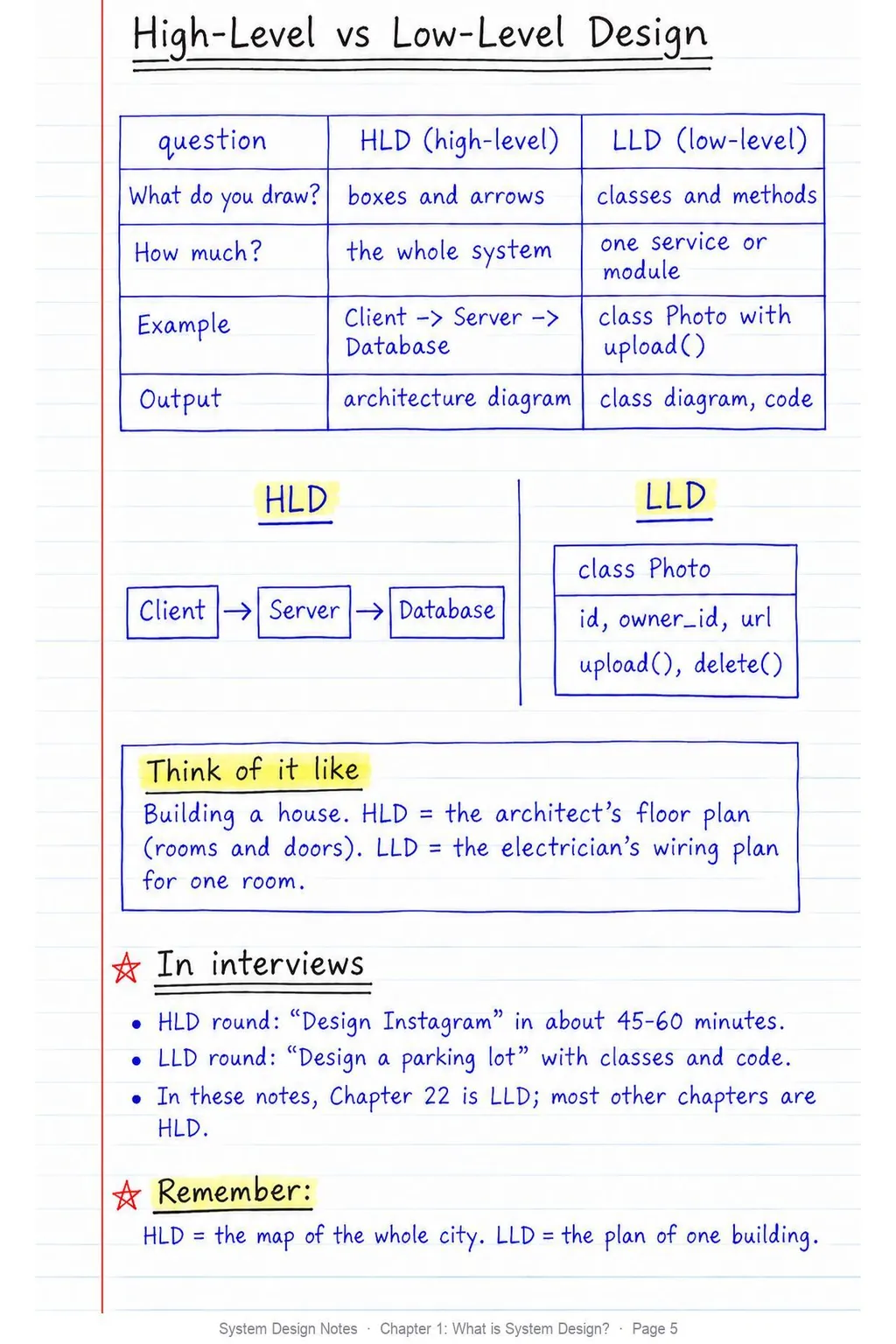
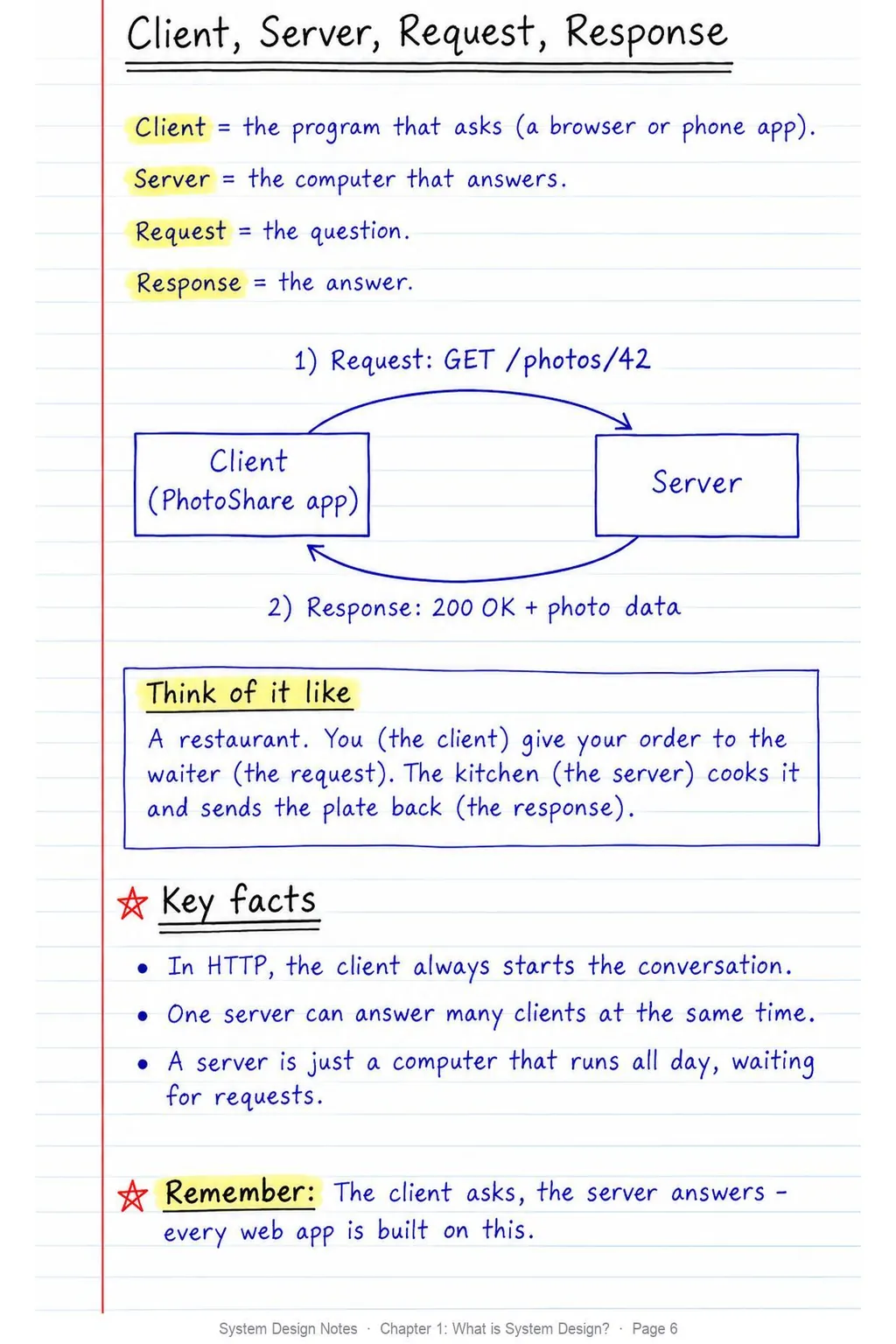
Get started with system design: what it is, high-level versus low-level design, clients, servers, requests and responses, the journey from one server to millions, functional versus non-functional requirements and why every design is a trade-off.
Learn how the internet works: IP addresses, ports and packets, OSI versus TCP/IP layers, DNS lookup, TCP and UDP, HTTP and HTTPS with the TLS handshake, HTTP/1.1 versus HTTP/2 versus HTTP/3 and what happens when you type a URL.
Estimate before you design: powers of 2 and data sizes, latency numbers, converting daily users to requests per second, storage, bandwidth and server counts, with a full worked estimate for PhotoShare.
Understand the core qualities of a system: scalability, scale up versus scale out, latency versus throughput and percentiles, availability and the nines, fault tolerance and SPOFs, SLA, SLO and SLI, stateless servers and maintainability.
Put the right front door on your system: forward and reverse proxies, load balancers and their algorithms, Layer 4 versus Layer 7, health checks, sticky sessions, avoiding a load balancer SPOF and the API gateway.
Serve content faster with a CDN: how copies close to users work, push versus pull CDNs, Cache-Control, TTL and invalidation, anycast and edge functions, and serving PhotoShare images from a CDN.
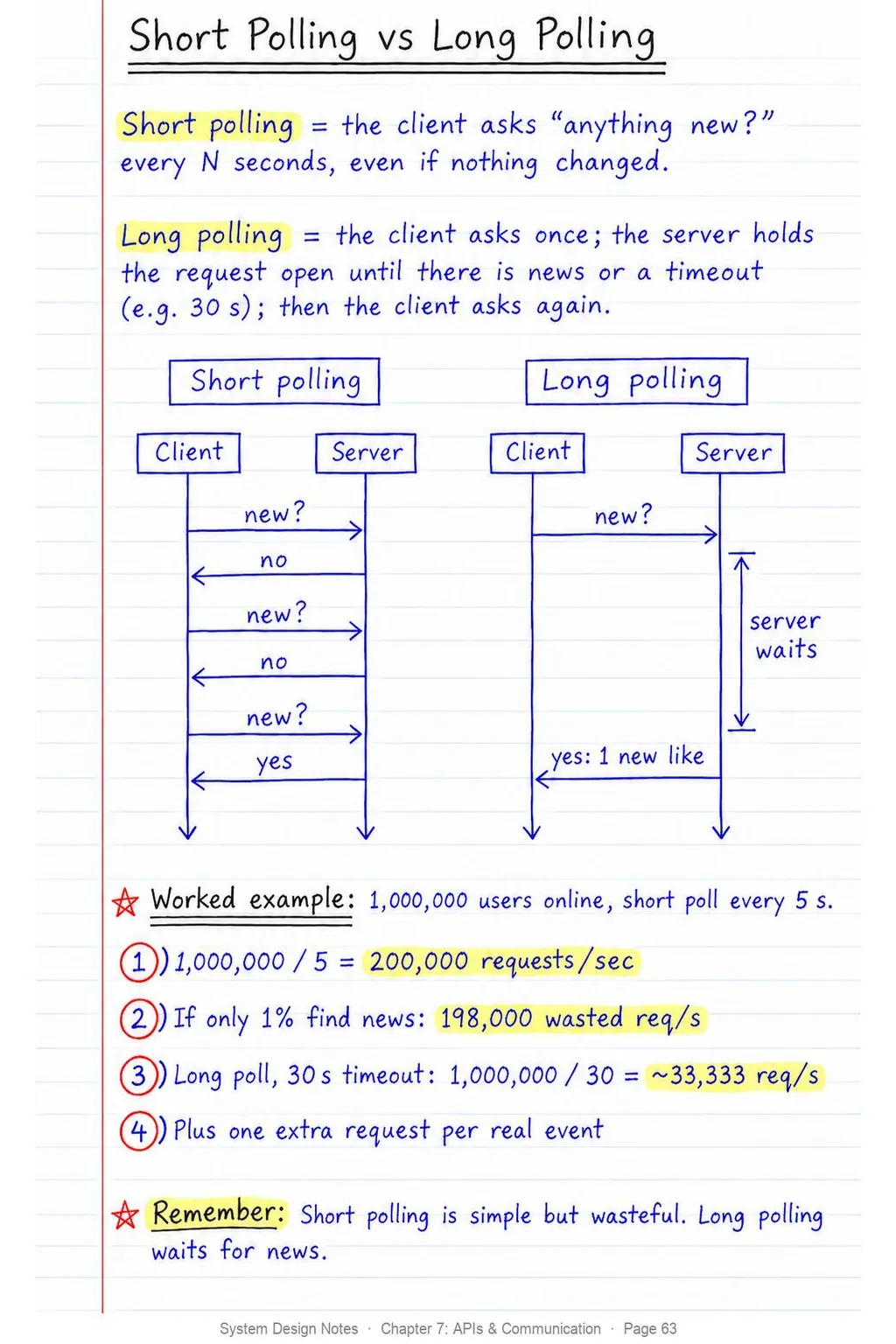
Design APIs and real-time communication: REST and good REST design, pagination, idempotency keys, GraphQL, gRPC, polling, WebSockets, server-sent events, webhooks and how to choose between them.
Master relational databases: tables and keys, normalization, ACID and transactions, isolation levels, indexes and B-trees, explain plans, N+1 queries, composite indexes and optimistic versus pessimistic locking.
Choose the right database: key-value, document, wide-column, graph, time-series and search stores, ACID versus BASE, LSM tree versus B-tree engines, and SQL versus NoSQL for each kind of job.
Scale your database: replication and read replicas, sync versus async, multi-leader and leaderless setups, partitioning and sharding strategies, hot shards, consistent hashing, virtual nodes, denormalization and cross-shard joins.
Use caching to keep hot data close: cache layers, cache-aside, read-through, write-through, write-back and write-around, eviction with LRU and LFU, TTL and invalidation, stampede and avalanche, Redis versus Memcached and caching PhotoShare feeds.
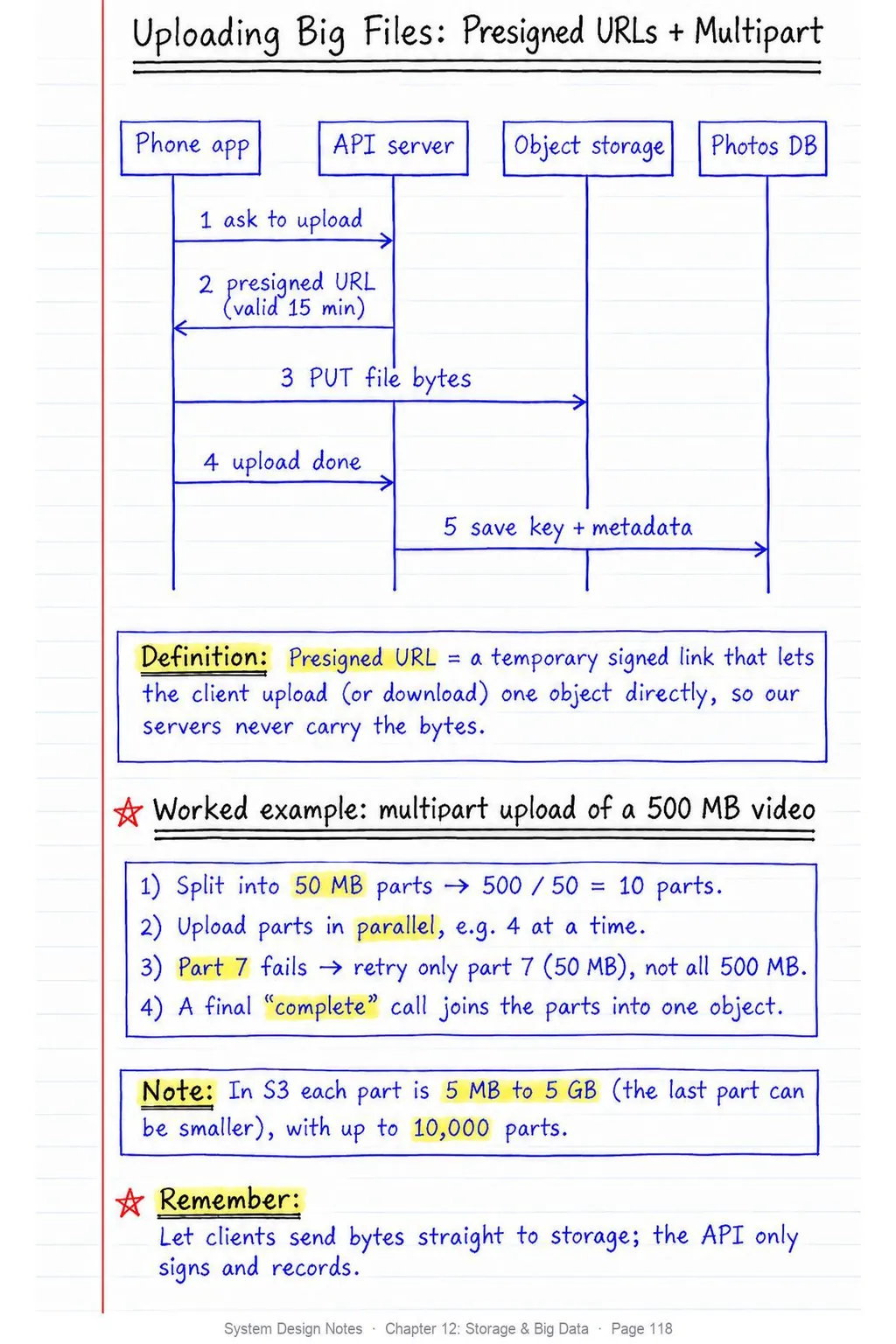
Store and process large data: block, file and object storage, S3, presigned URLs and multipart uploads, HDFS, OLTP versus OLAP, data lakes and warehouses, ETL versus ELT, MapReduce and stream processing.
Learn the theory behind distributed systems: the 8 fallacies, CAP and PACELC, consistency models, quorums, clocks and vector clocks, consensus and Raft, heartbeats, split brain, fencing and gossip.
Keep data correct across services: two-phase commit, sagas, compensating actions, the transactional outbox and CDC, delivery guarantees, and unique ID schemes including Snowflake.
Build with messaging and events: queues, pub/sub, Kafka topics, partitions and consumer groups, RabbitMQ versus Kafka versus SQS, retries and dead-letter queues, backpressure, event-driven design, event sourcing, CQRS and an async thumbnail pipeline.
Choose an architecture style: monolith versus microservices, bounded contexts, service discovery, sidecars and service mesh, BFF, serverless and cold starts, the strangler fig migration, and layered, hexagonal and clean architecture.
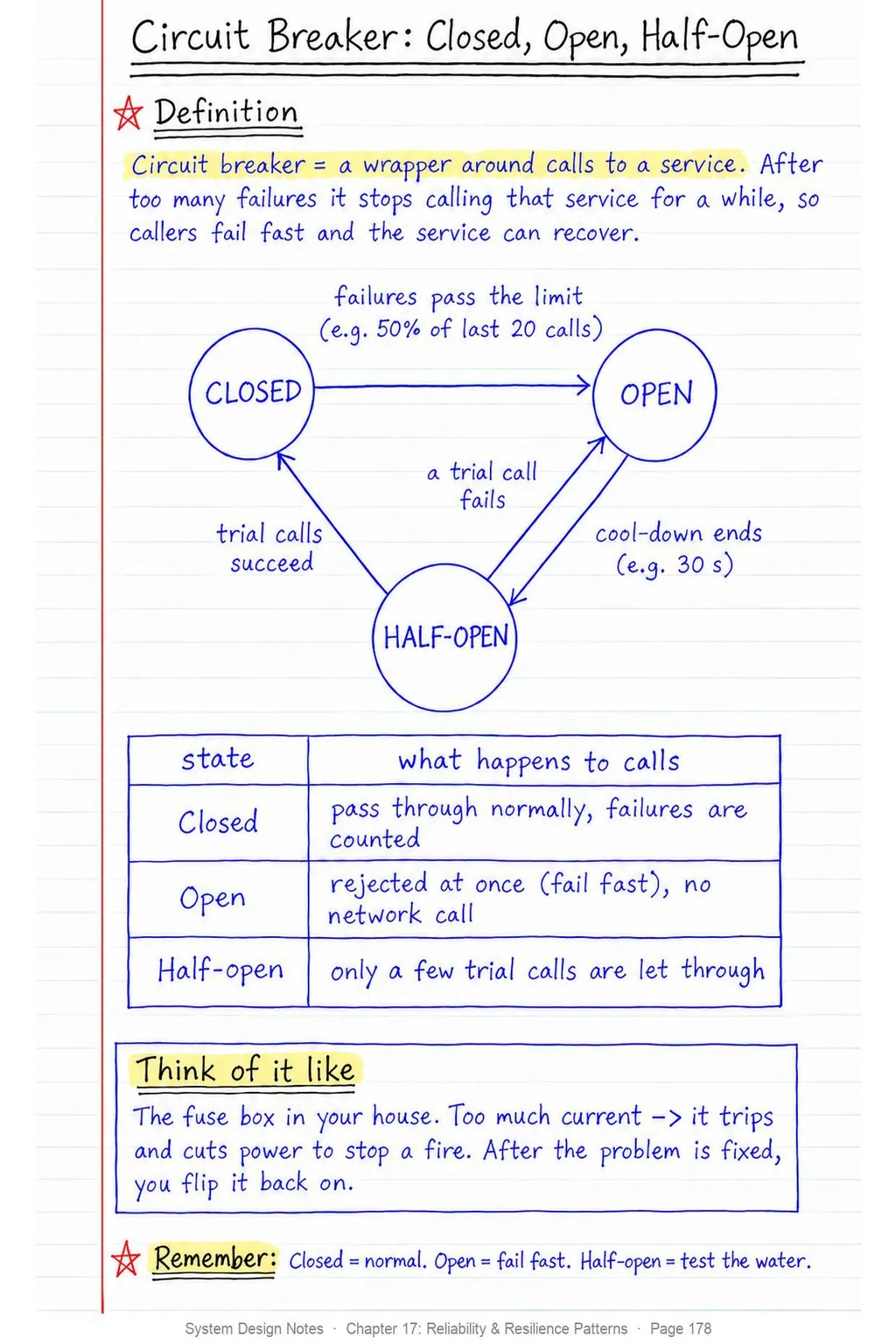
Build systems that survive failure: timeouts, retries with backoff and jitter, circuit breakers, bulkheads, rate limiting algorithms, graceful degradation, failover, backups with RPO and RTO, and multi-region design.
Secure your design: authentication versus authorization, password hashing, sessions versus JWT, OAuth 2.0 with PKCE, OpenID Connect and SSO, RBAC versus ABAC, encryption, secrets management, common web attacks, DDoS protection and zero trust.
See inside running systems with observability: logs, metrics, the golden signals, RED and USE, distributed tracing, SLO-based alerting, dashboards and the tool stack, on-call and postmortems.
Deploy and run your system in the cloud: VMs versus containers, Docker, Kubernetes, autoscaling, CI/CD, rolling, blue-green and canary releases, feature flags, infrastructure as code, regions and zones, the AWS, GCP and Azure service map and cost.
Use special data structures for scale: Bloom filters, Count-Min Sketch, HyperLogLog, inverted indexes, tries, geohash, quadtrees, Merkle trees, skip lists, ring buffers and write-ahead logs.
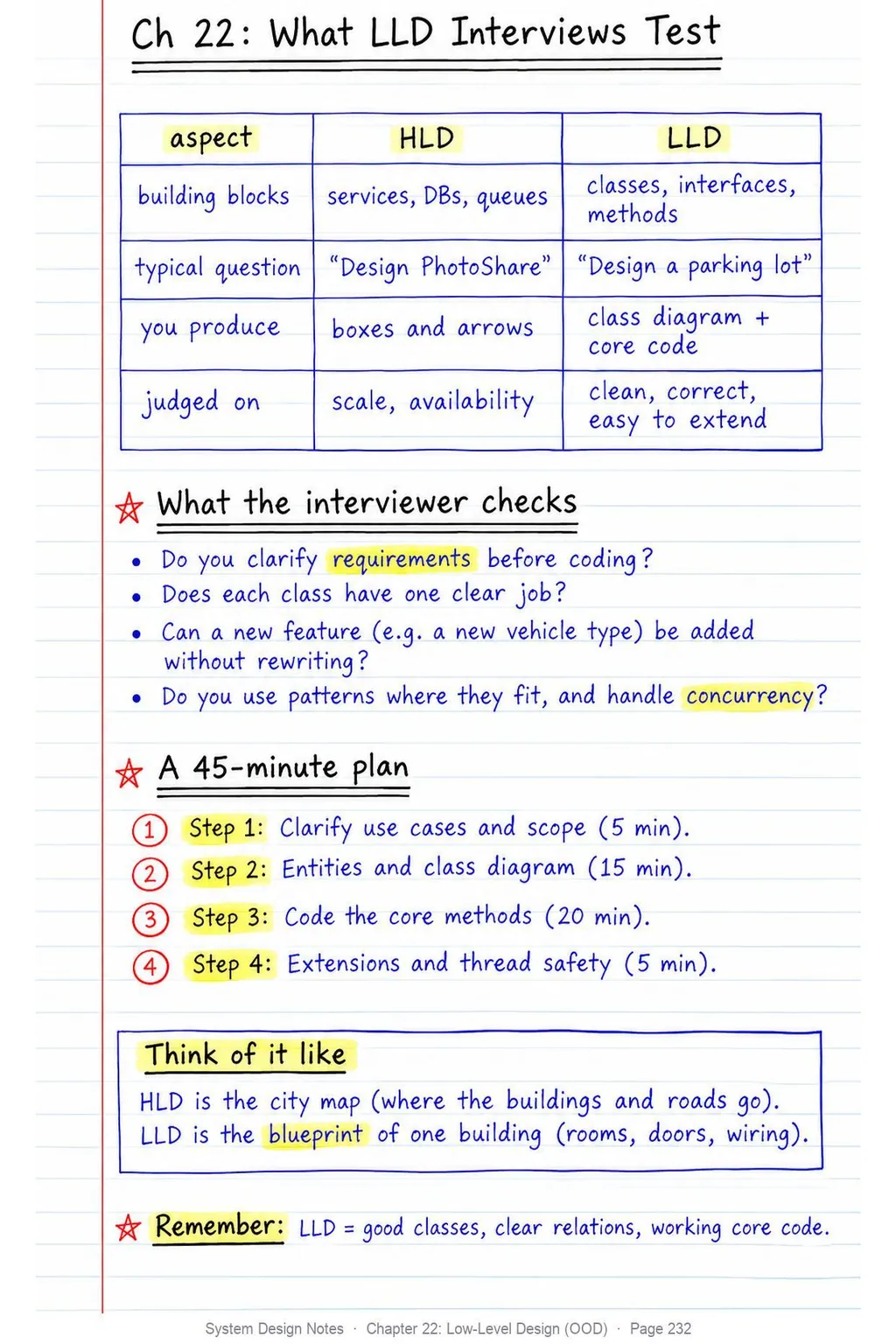
Prepare for low-level design: the 4 pillars of OOP, UML class diagrams, SOLID, creational, structural and behavioral patterns, a step-by-step LLD approach, worked designs for a parking lot, LRU cache, elevator and ticket booking, and concurrency basics.
Follow a framework for the system design interview: the 4 steps, asking before you draw, the high-level design, deep dives and trade-offs, and the common mistakes to avoid.
Design classic building blocks step by step: a URL shortener, distributed rate limiter, key-value store, notification system, web crawler and unique ID generator.
Design social and media systems: a WhatsApp-style chat app, news feed with fan-out strategies, YouTube-style video streaming, Dropbox-style file storage and search autocomplete.
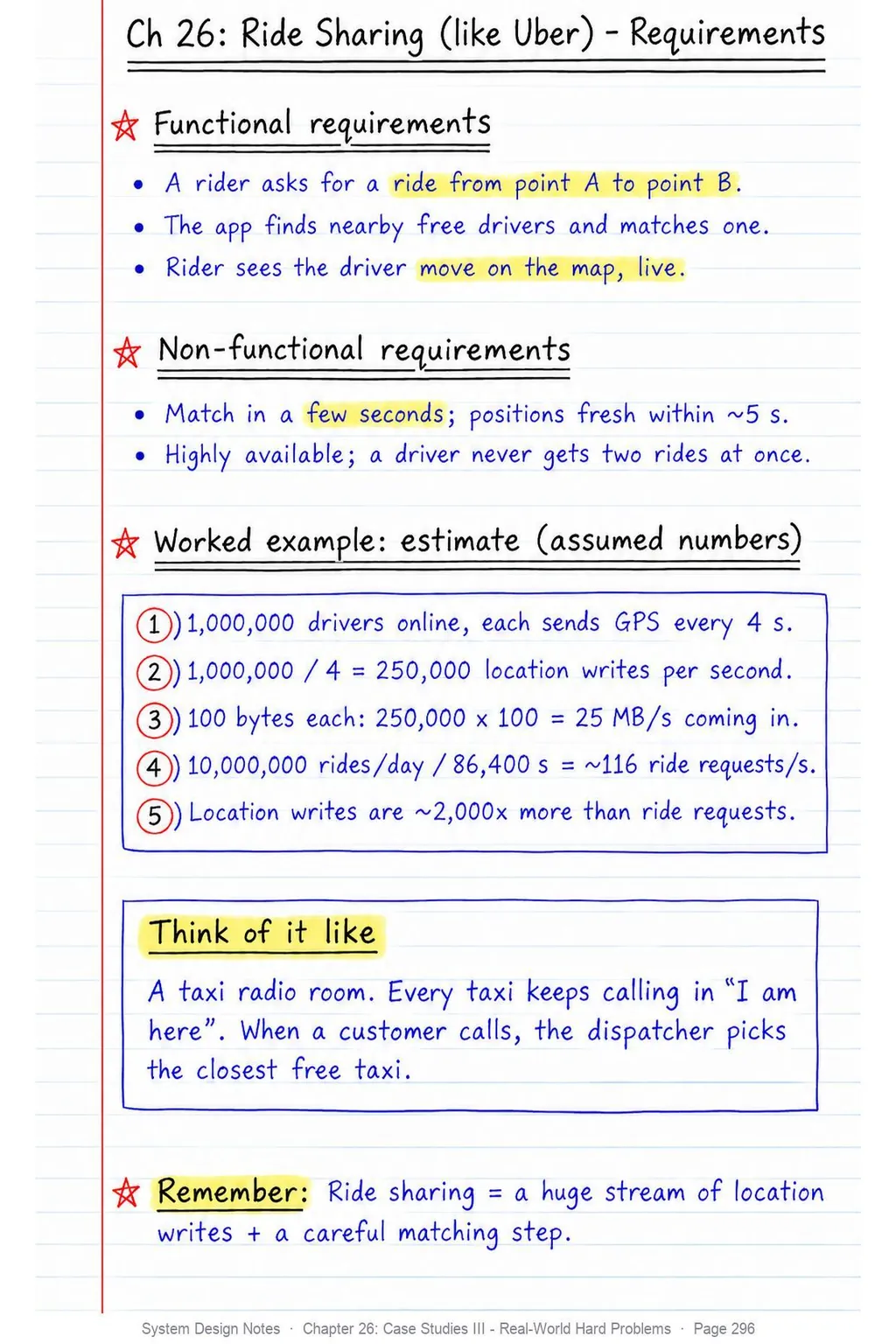
Tackle hard real-world problems: ride sharing with geohash, ticket booking without double booking, payment systems with ledgers and idempotency, collaborative editing with OT and CRDT, job schedulers, leaderboards and metrics systems.
Design AI and ML systems: feature stores, model serving, recommendation systems, LLM serving with KV cache, LLM gateways, RAG at scale, vector databases, agent systems, a ChatGPT-like service and production evals, drift and A/B tests.
Review everything and plan your next steps: the whole PhotoShare architecture, a numbers cheat sheet, top 10 trade-offs, a component-to-problem map, a patterns cheat sheet, an interview day checklist and a learning roadmap.
Watch before you buy
Students on All Notes PDF
Real students talking about how they revise with our handwritten notes.
How it works
Get your notes in 3 easy steps
No app, no waiting. The whole thing takes under a minute.
- STEP 110 sec
Choose your notes
One subject, any two, or a full class set.
- STEP 230 sec
Pay with UPI or card
GPay, PhonePe, Paytm or card. Pay once, no subscription.
- STEP 3Instant
Download your PDFs
Tap Download on any chapter. Links never expire.
- Log in
- My library
- Download
What you get
- Format
- Downloadable PDF (not a printed book)
- Chapters
- 28 chapters in one 336 page PDF
- Level
- System Design from beginner to advanced. No experience needed
- Style
- Handwritten-style notes with diagrams, code explained line by line, common mistakes and quizzes
- Devices
- Phone, tablet and laptop. Print any chapter if you like
- Access
- Lifetime. Download again anytime from My library
- Instant downloadRight after payment
- Free updatesCorrections added free
- Secure paymentUPI, cards, net banking