Tech · Beginner to Advanced · Handwritten PDF notes
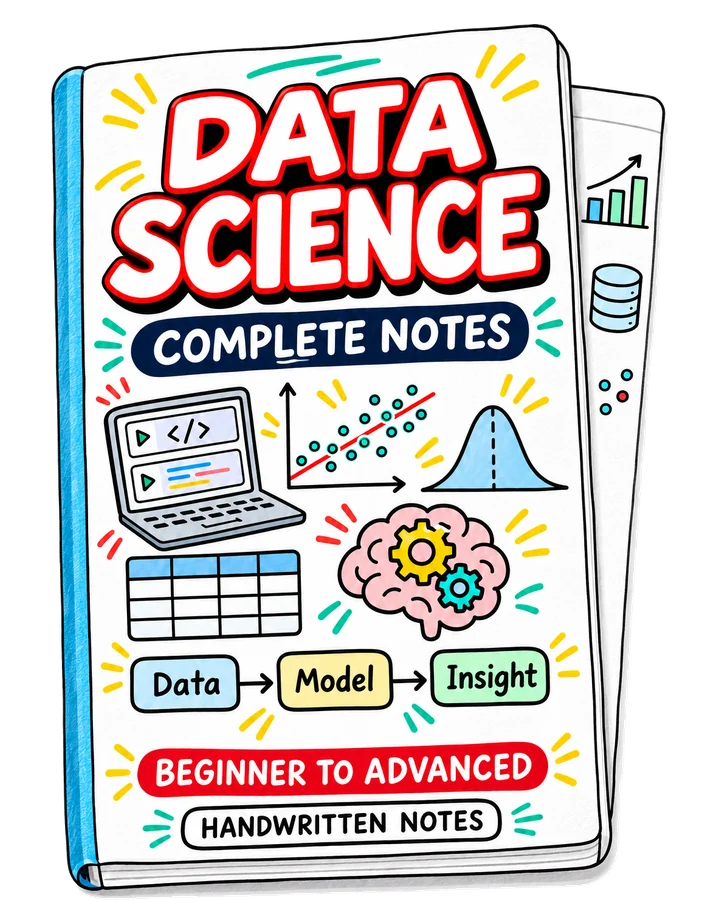
Data Science Complete Notes
Instant PDF download after payment. Pay once, keep forever.
- Instant download
- Lifetime access
- UPI, GPay, PhonePe, cards
Complete coverage
What you learn in all 28 chapters
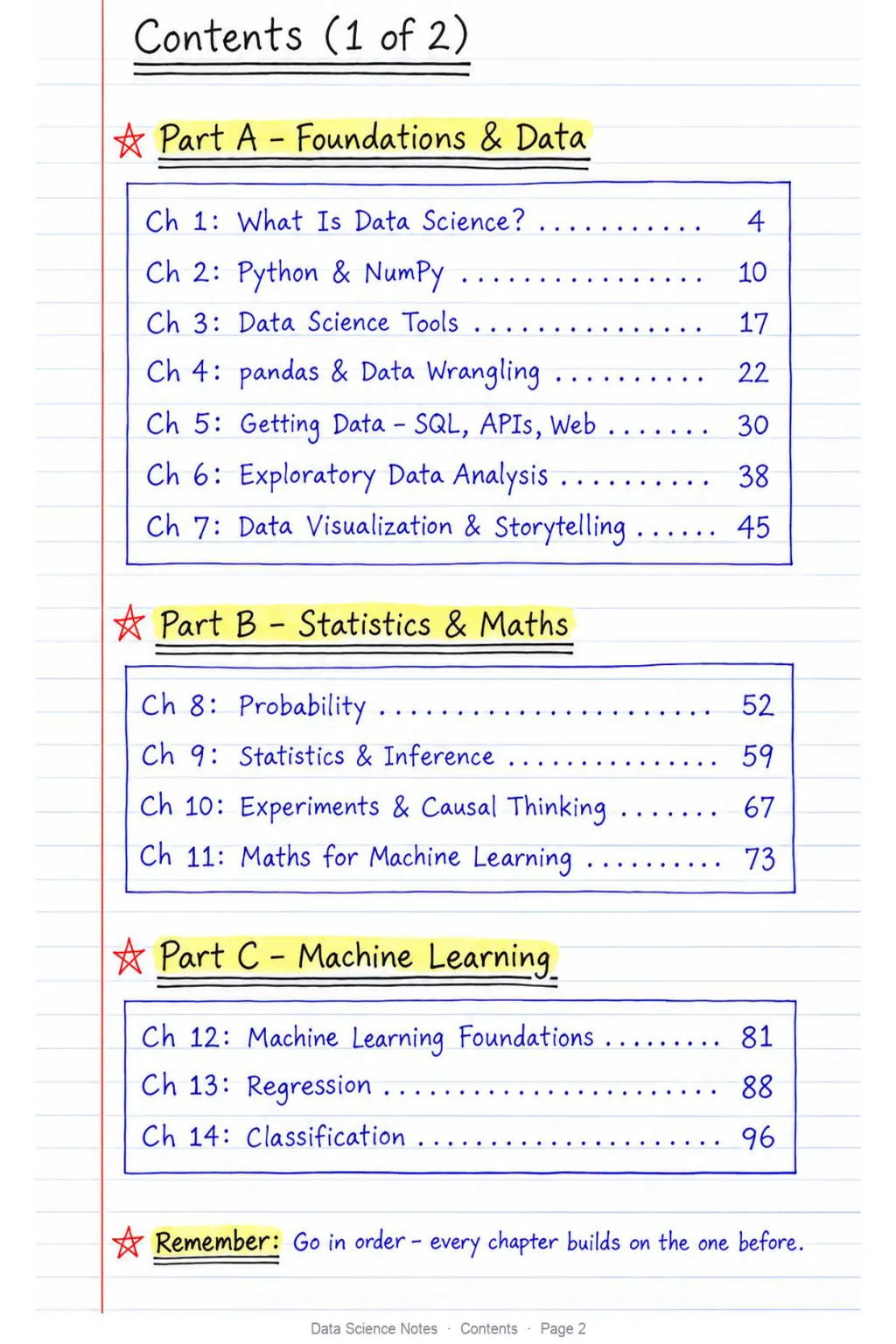
Open any chapter to see every topic it covers and the page it is on.
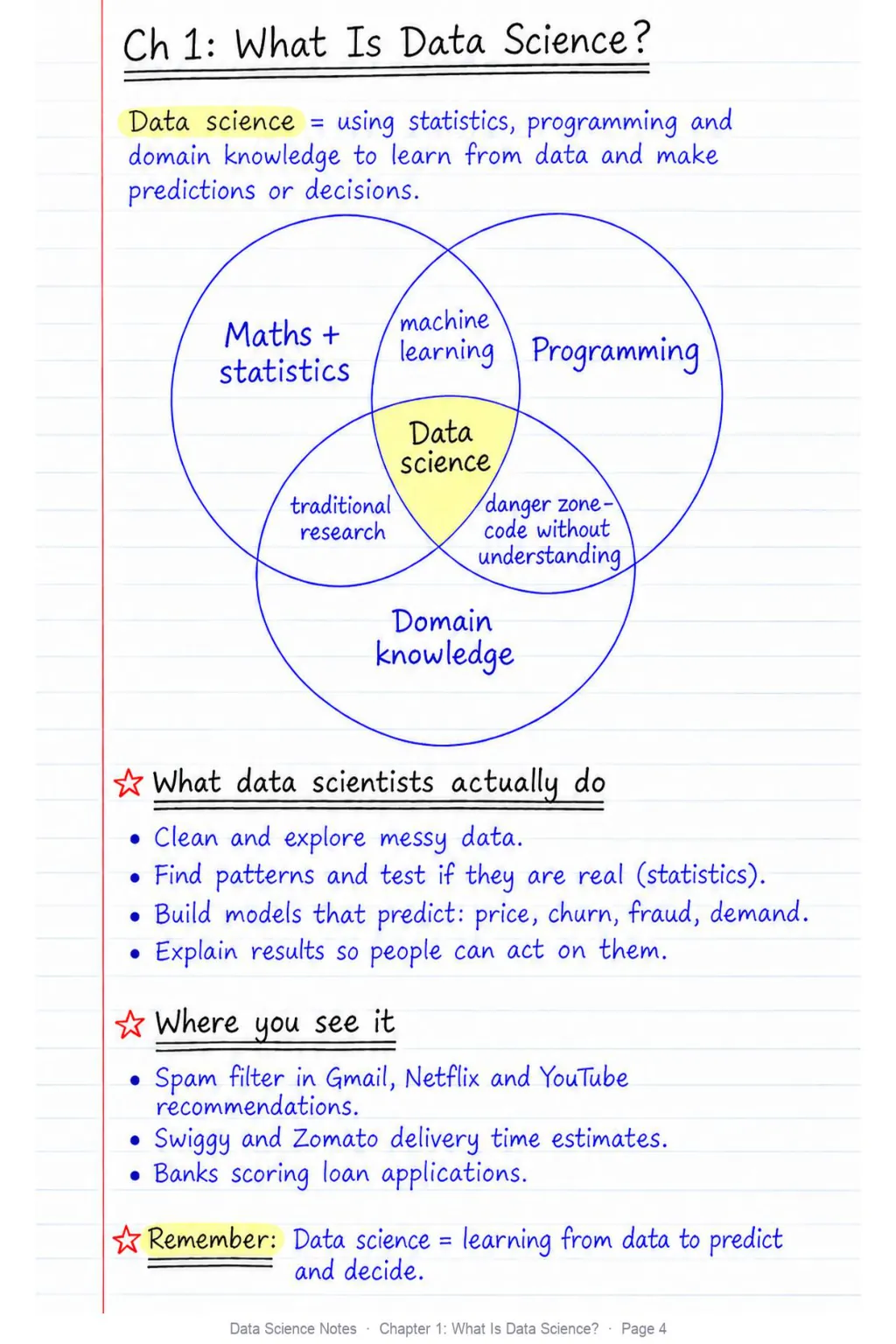
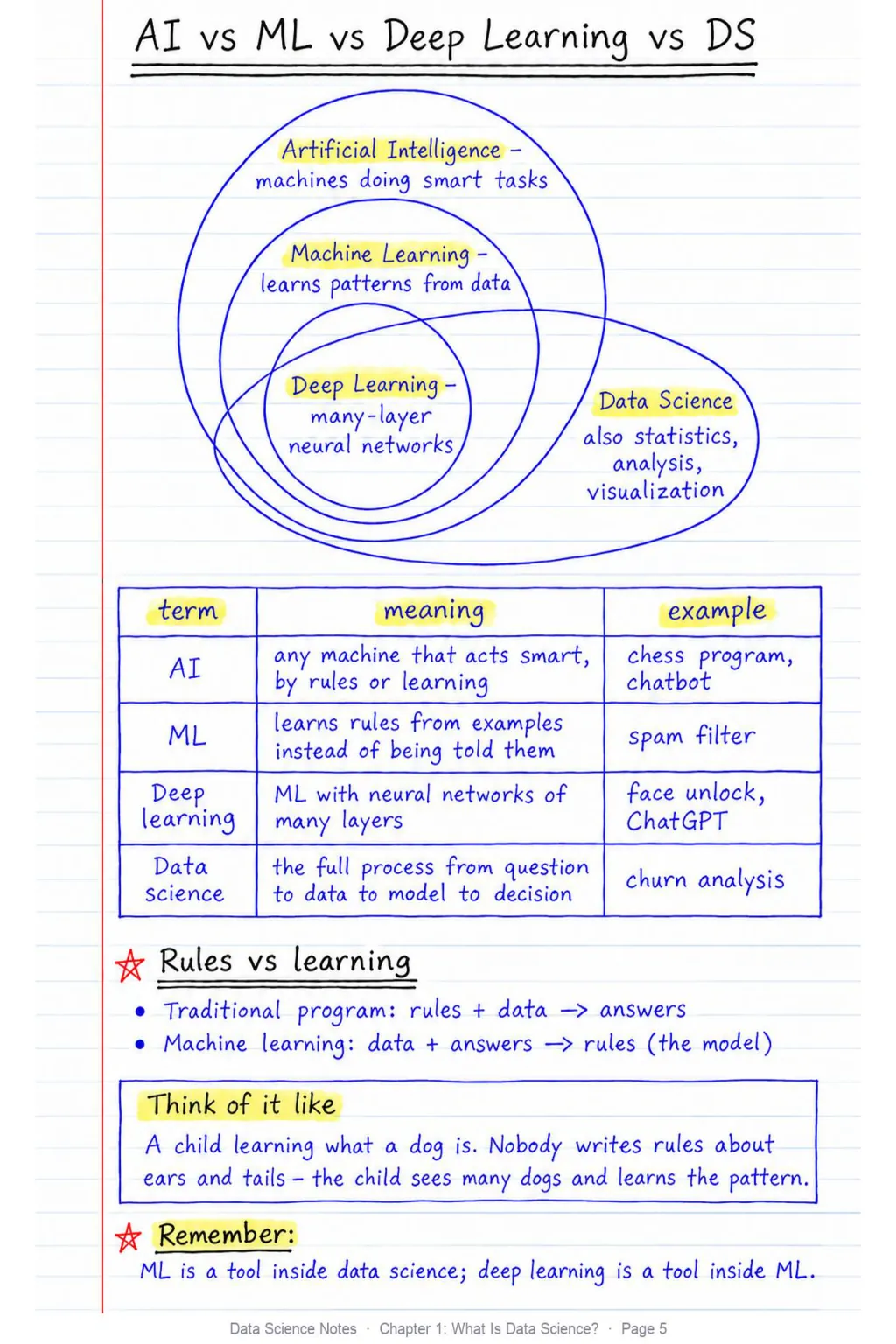
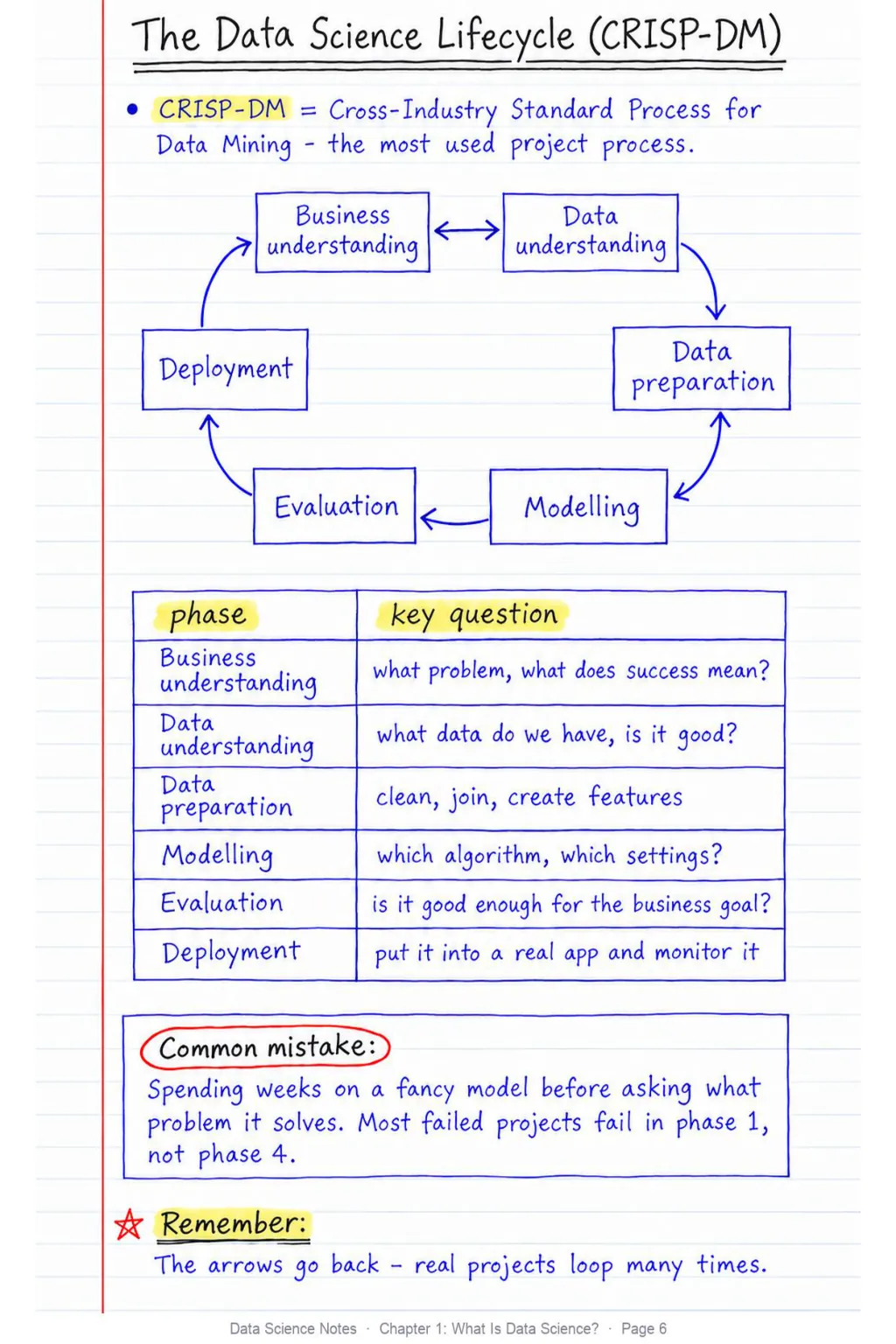
Understand what data science is: how AI, ML, deep learning and data science relate, the CRISP-DM lifecycle, roles in a data team, the types of ML problems and the toolkit and datasets used.
Learn the Python and NumPy that data science needs: core data structures, functions, lambdas and comprehensions, NumPy arrays, indexing and boolean masks, vectorisation, broadcasting and axes.
Set up a professional workflow: Jupyter and Google Colab, packages and environments, Git and GitHub, and organising a data science project.
Wrangle data with pandas: load and inspect data, select and filter, create columns, groupby, handle missing values, reshape with melt and pivot, merge, and work with text and dates.
Get data from anywhere: SQL from Python with joins, CTEs and windows, APIs and JSON, web scraping, big files and memory, and checking data when it arrives.
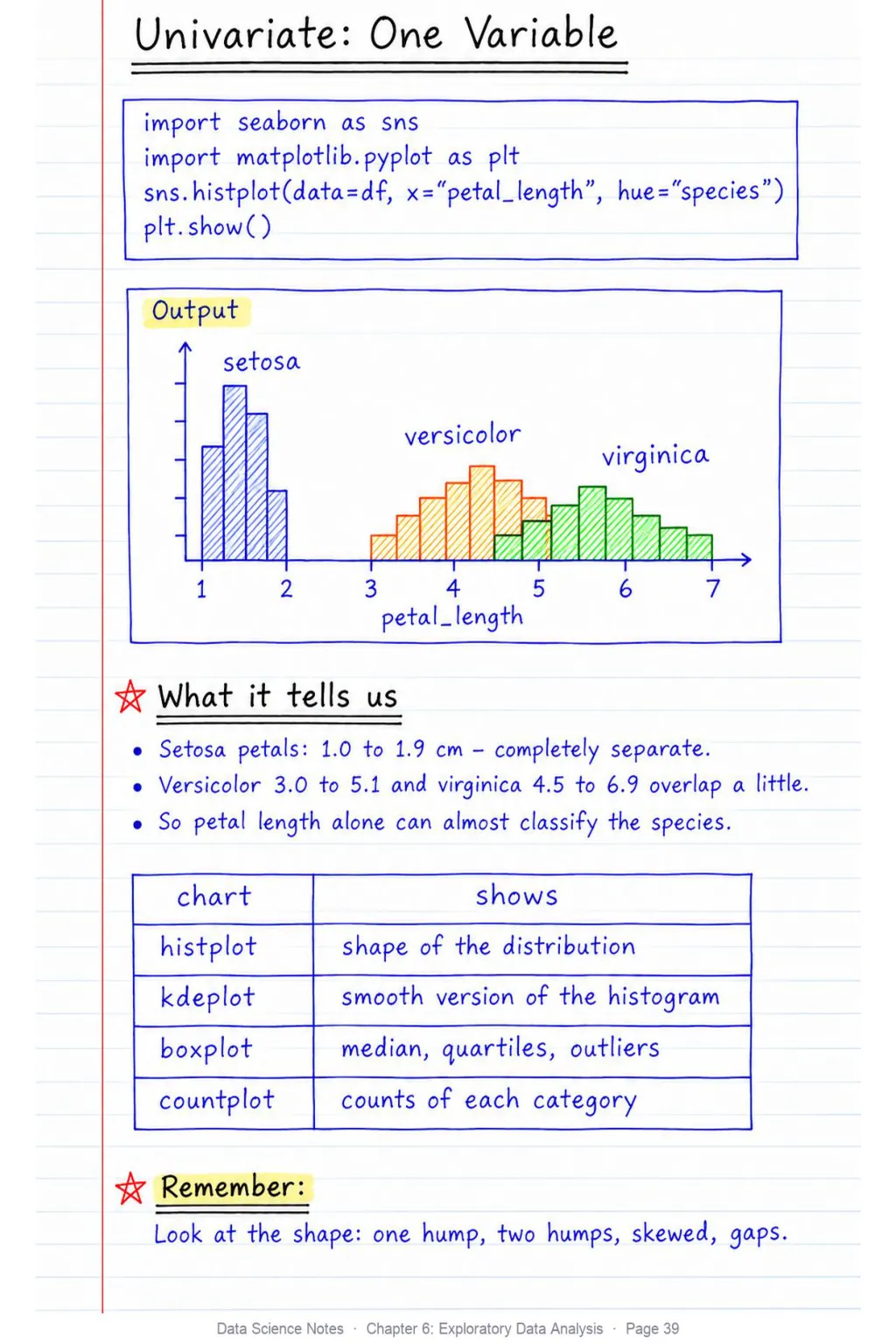
Explore data before modelling: univariate and bivariate analysis, correlation matrices, outliers and skew, and studying the target variable.
Visualise and tell stories: matplotlib figures and subplots, choosing charts, seaborn statistical charts, interactive Plotly charts, design rules and storytelling with data.
Build probability intuition: probability rules, conditional probability and Bayes, random variables and expected value, binomial, Poisson and normal distributions, and the central limit theorem.
Draw conclusions from data: descriptive statistics, standard error, confidence intervals, hypothesis tests, t-tests, ANOVA and chi-square, and A/B testing in practice.
Think causally: design good experiments, power and sample size, Bayesian thinking, confounders and Simpson's paradox, and causal inference without experiments.
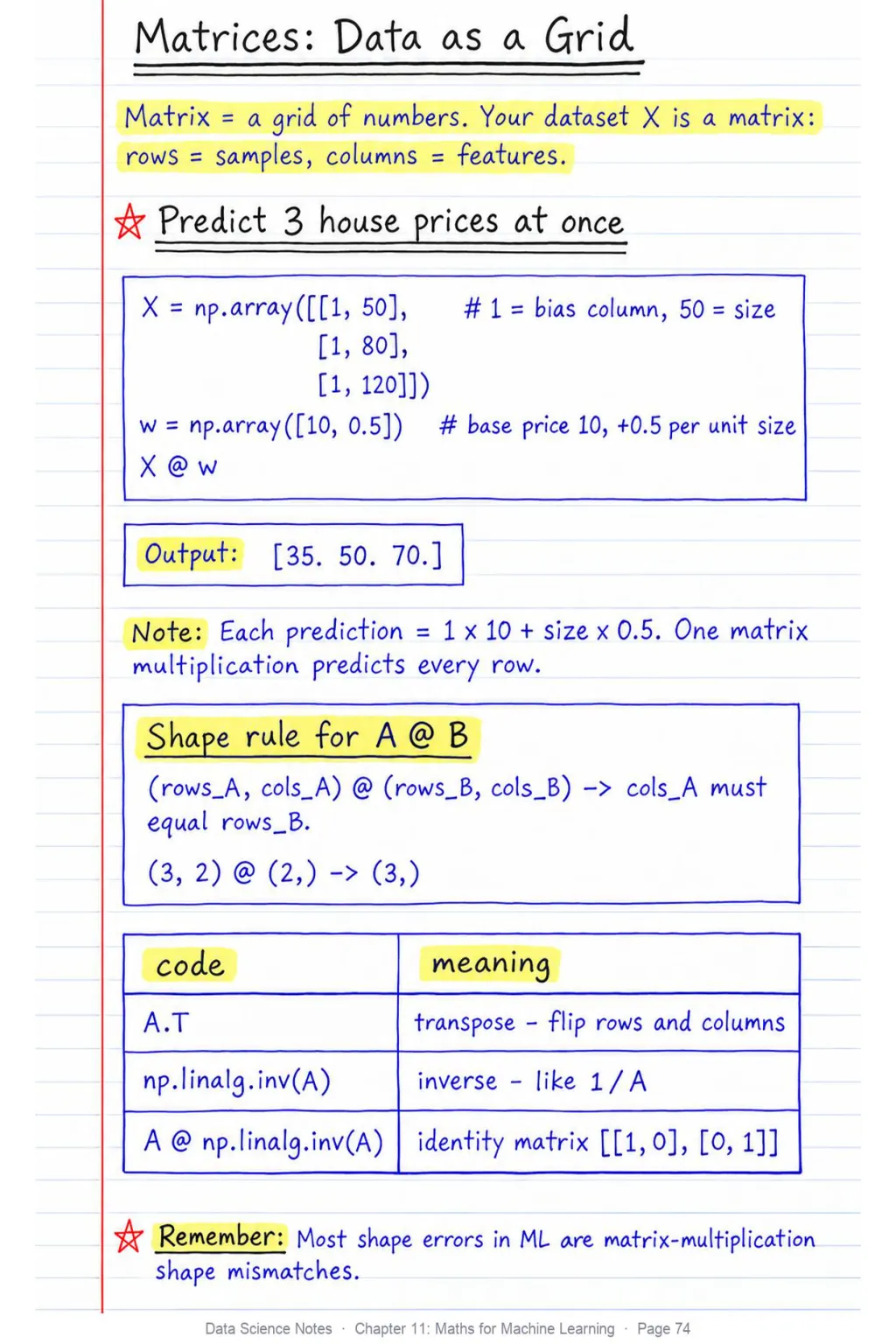
Learn the maths behind ML without fear: vectors and dot products, matrices, derivatives, gradient descent, loss functions, eigenvectors and SVD, and the chain rule.
Understand how models learn: train/test splits, the scikit-learn pattern, underfitting and overfitting, validation and cross-validation, baselines and choosing a model.
Predict numbers with regression: simple and multiple linear regression, metrics, coefficients and residuals, polynomial regression, Ridge and Lasso, and comparing models.
Predict categories with classification: logistic regression on real data, the confusion matrix, precision, recall and F1, thresholds, ROC and AUC, imbalanced classes and other classifiers.
Learn kNN, Naive Bayes and SVMs: nearest neighbours, the curse of dimensionality, Naive Bayes, support vector machines, kernels for curved boundaries and tuning.
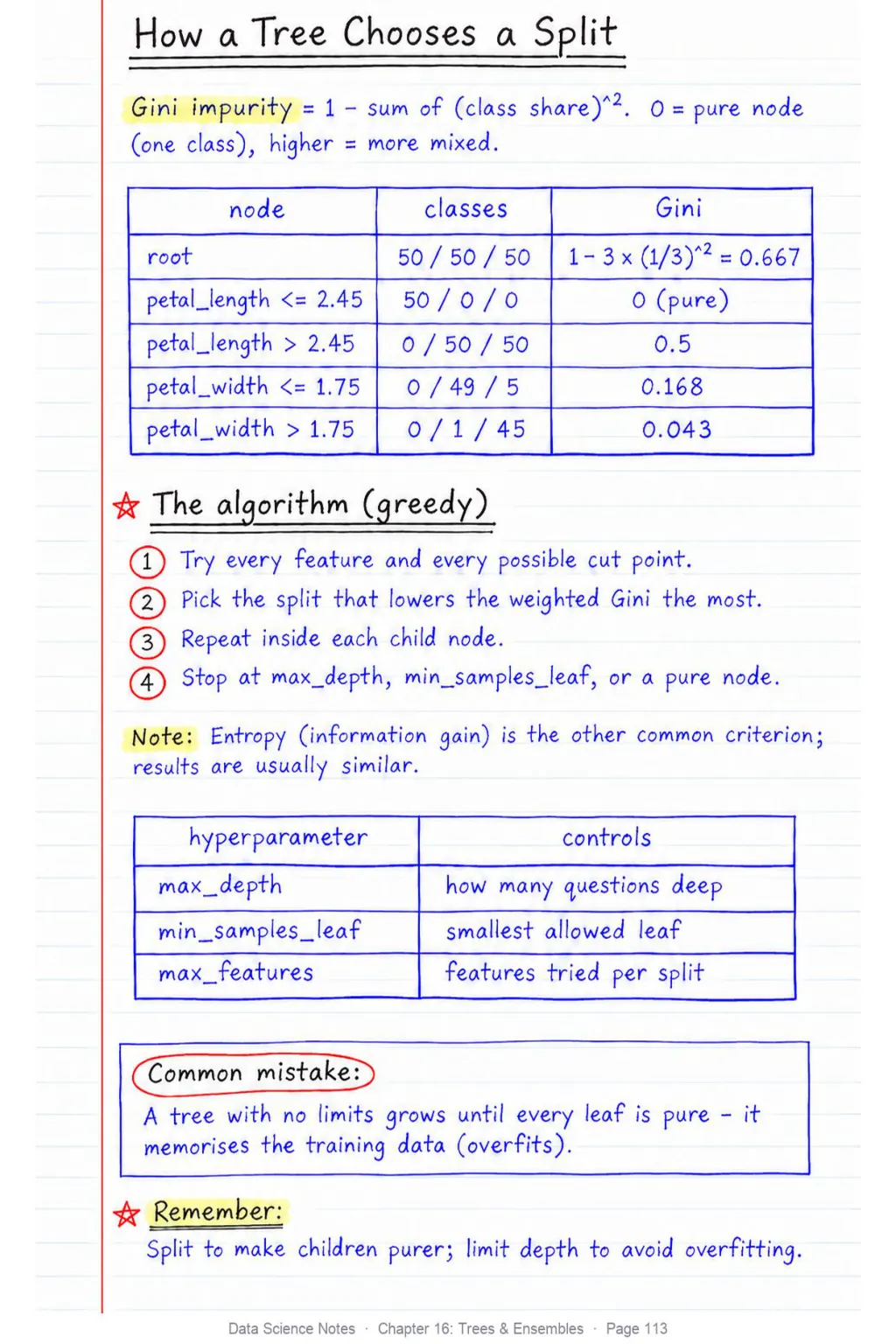
Master trees and ensembles: decision trees and how they split, random forests, feature importance, gradient boosting, and XGBoost and LightGBM with early stopping.
Build better models: feature scaling and encoding, feature engineering and data leakage, pipelines and ColumnTransformer, grid and random search, honest validation and feature selection.
Evaluate and explain models: learning and validation curves, probability calibration, feature importance, partial dependence and SHAP, and error analysis.
Find patterns without labels: k-means and choosing k, hierarchical clustering and DBSCAN, PCA, anomaly detection, t-SNE and UMAP, and market basket analysis.
Forecast the future with time series: decomposition, stationarity and autocorrelation, baselines and metrics, ARIMA and SARIMA, exponential smoothing, Prophet and ML forecasting.
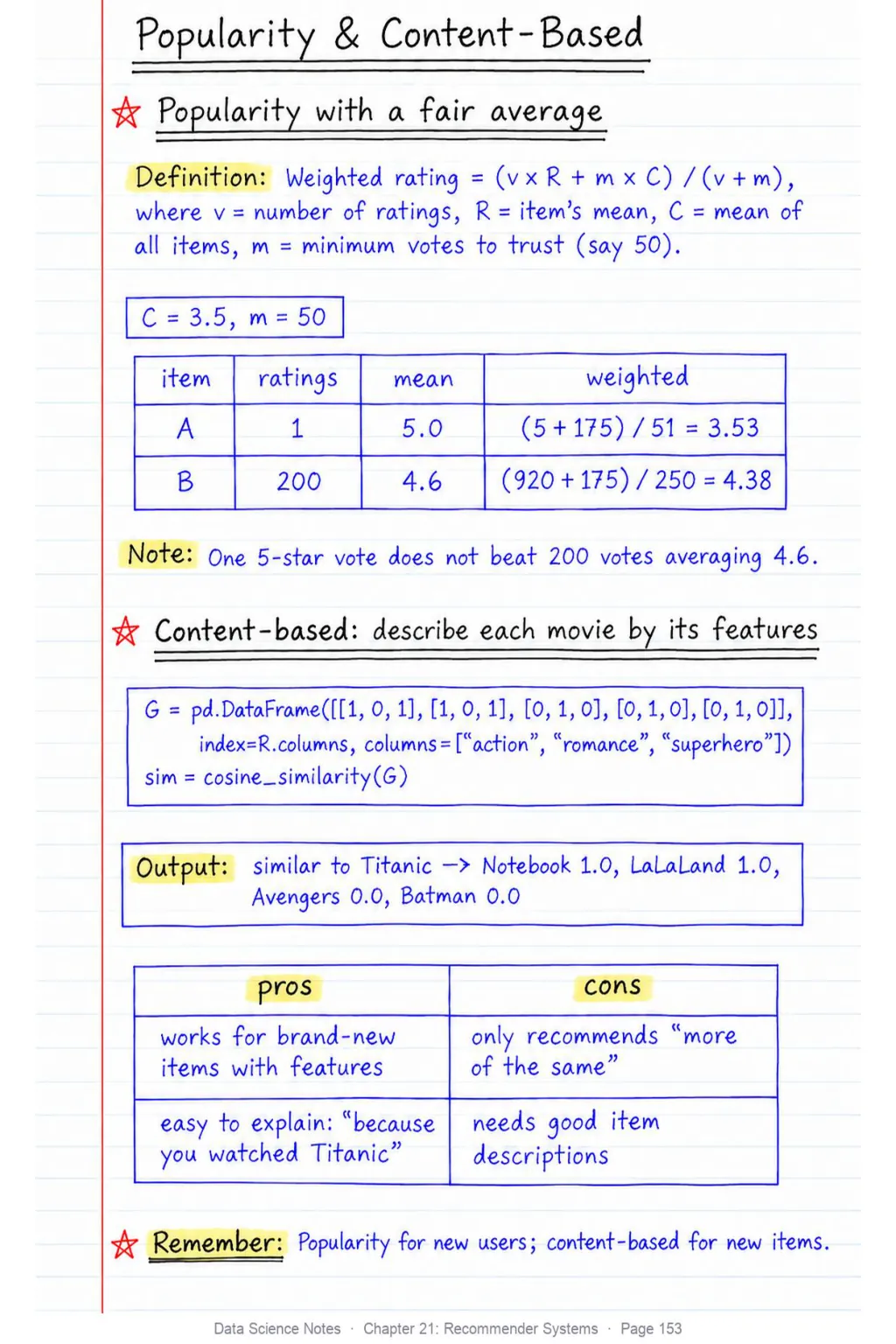
Build recommender systems: popularity and content-based methods, collaborative filtering, matrix factorisation and evaluating recommendations.
Learn deep learning fundamentals: neurons, activation functions, how networks train, CNNs, RNNs and transformers, training in PyTorch, and optimisers and regularisation.
Work with images: how convolution and pooling work, CNN architectures, training a CNN on digits, augmentation, transfer learning and computer vision tasks.
Work with text: turning text into numbers, a sentiment classifier, embeddings, RNNs and LSTMs, attention, BERT versus GPT, LLMs and prompting, RAG and fine-tuning.
Learn reinforcement learning: trial and reward, multi-armed bandits, Q-learning, deep RL and real-world uses.
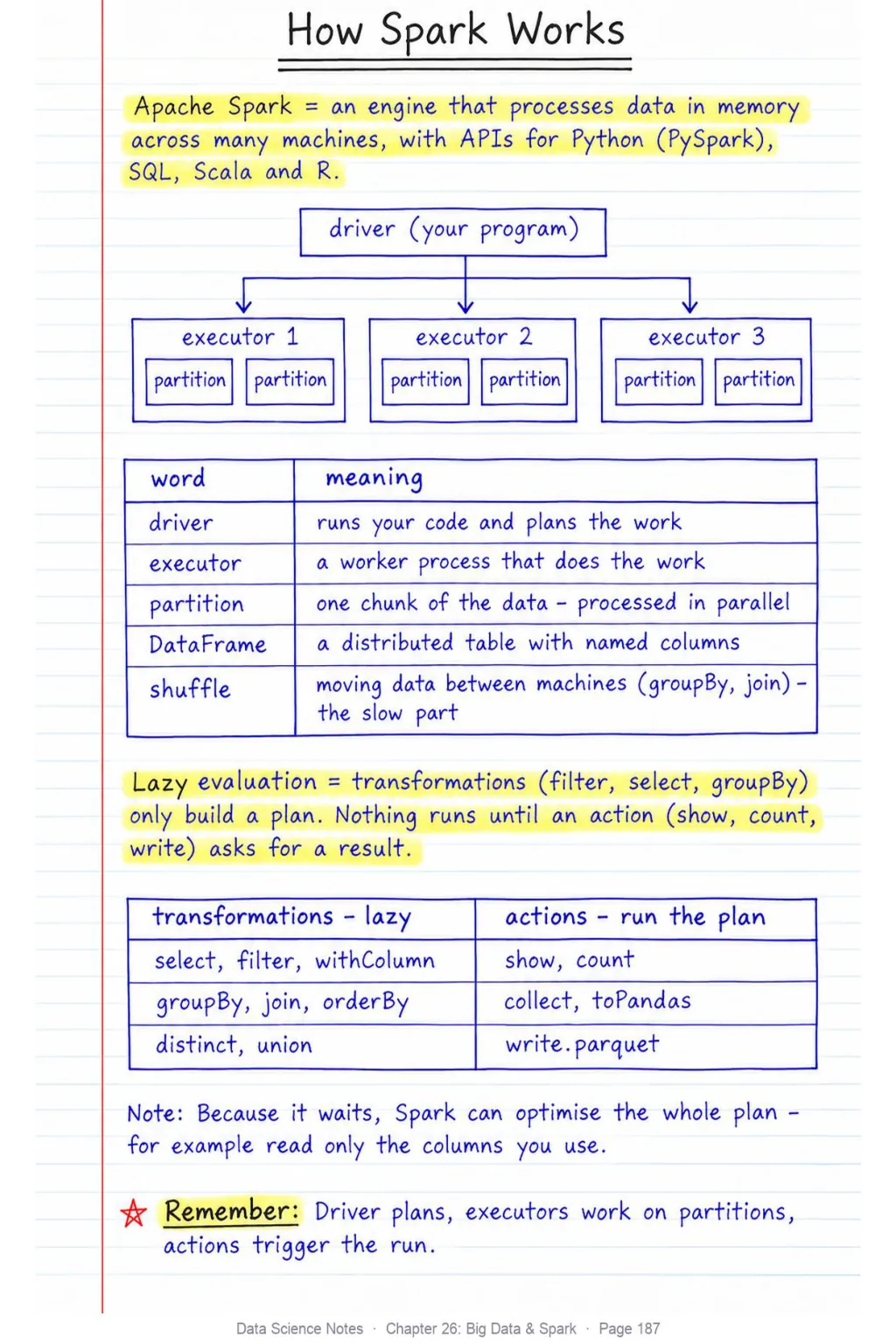
Handle big data: when data is big, how Spark works, PySpark DataFrames and SQL, fast single-machine tools Polars and DuckDB, and data pipelines with Spark ML.
Take a project to production: frame the problem, model and tune, choose a threshold, save the model and serve an API, MLOps, responsible AI, your portfolio and Kaggle.
Revise with stats, scikit-learn and advanced cheat sheets, practise interview questions on concepts, algorithms, deep learning, SQL and case studies, and follow the data science roadmap.
Watch before you buy
Students on All Notes PDF
Real students talking about how they revise with our handwritten notes.
How it works
Get your notes in 3 easy steps
No app, no waiting. The whole thing takes under a minute.
- STEP 110 sec
Choose your notes
One subject, any two, or a full class set.
- STEP 230 sec
Pay with UPI or card
GPay, PhonePe, Paytm or card. Pay once, no subscription.
- STEP 3Instant
Download your PDFs
Tap Download on any chapter. Links never expire.
- Log in
- My library
- Download
What you get
- Format
- Downloadable PDF (not a printed book)
- Chapters
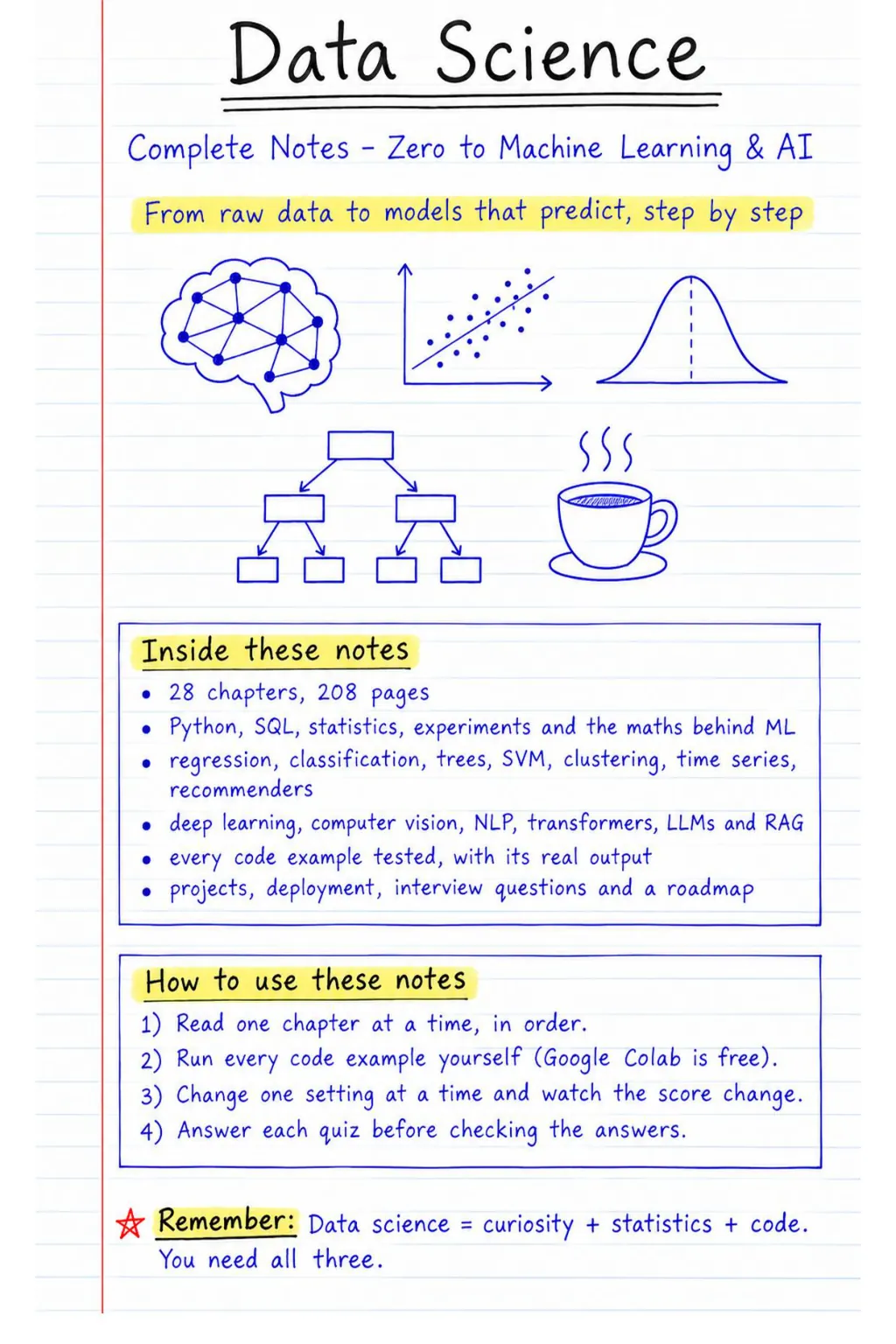
- 28 chapters in one 208 page PDF
- Level
- Data Science from beginner to advanced. No experience needed
- Style
- Handwritten-style notes with diagrams, code explained line by line, common mistakes and quizzes
- Devices
- Phone, tablet and laptop. Print any chapter if you like
- Access
- Lifetime. Download again anytime from My library
- Instant downloadRight after payment
- Free updatesCorrections added free
- Secure paymentUPI, cards, net banking