Tech · Beginner to Advanced · Handwritten PDF notes
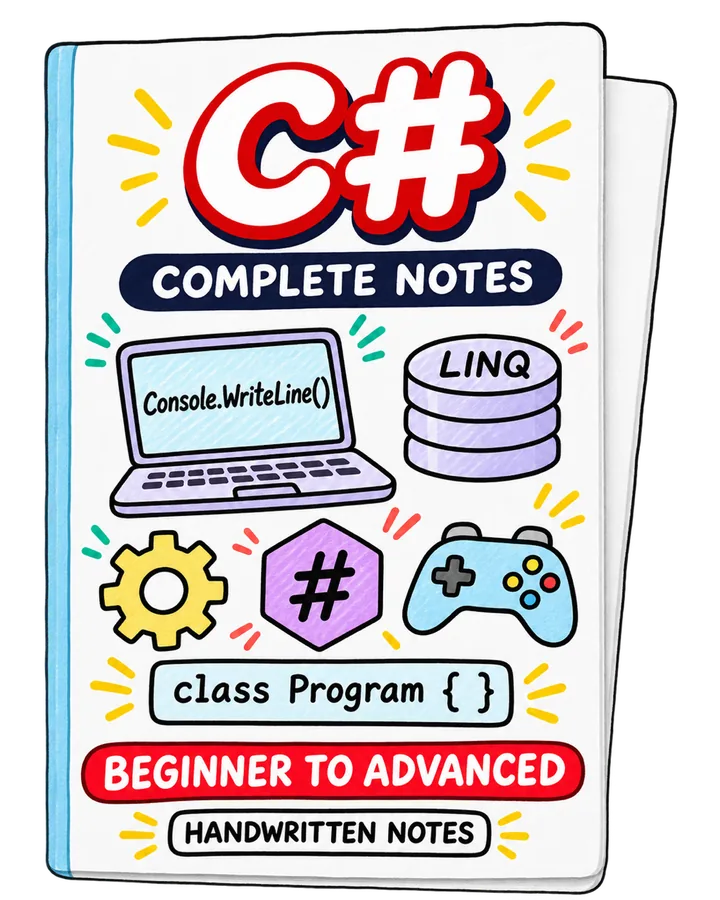
C# Complete Notes
Instant PDF download after payment. Pay once, keep forever.
- Instant download
- Lifetime access
- UPI, GPay, PhonePe, cards
Complete coverage
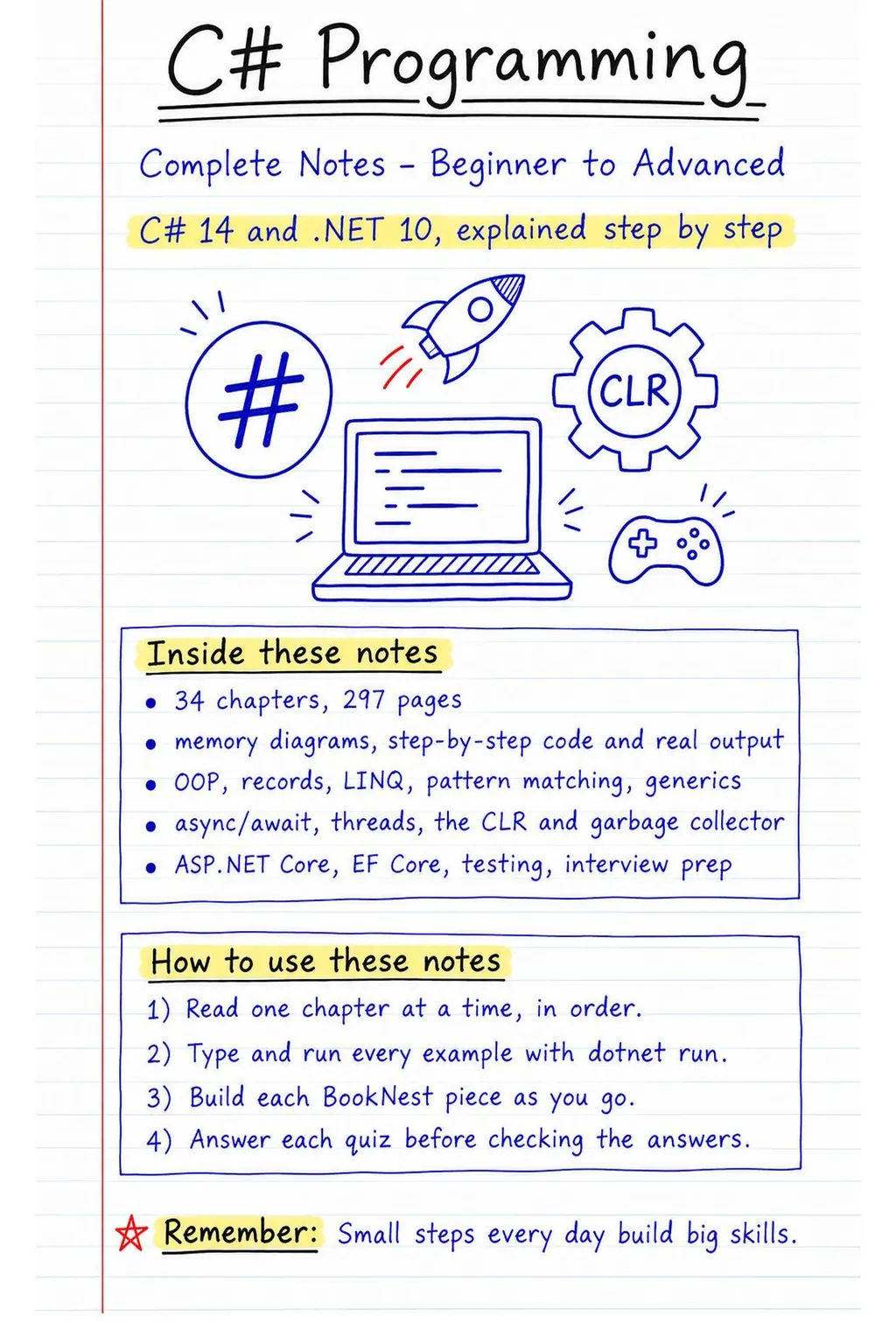
What you learn in all 34 chapters
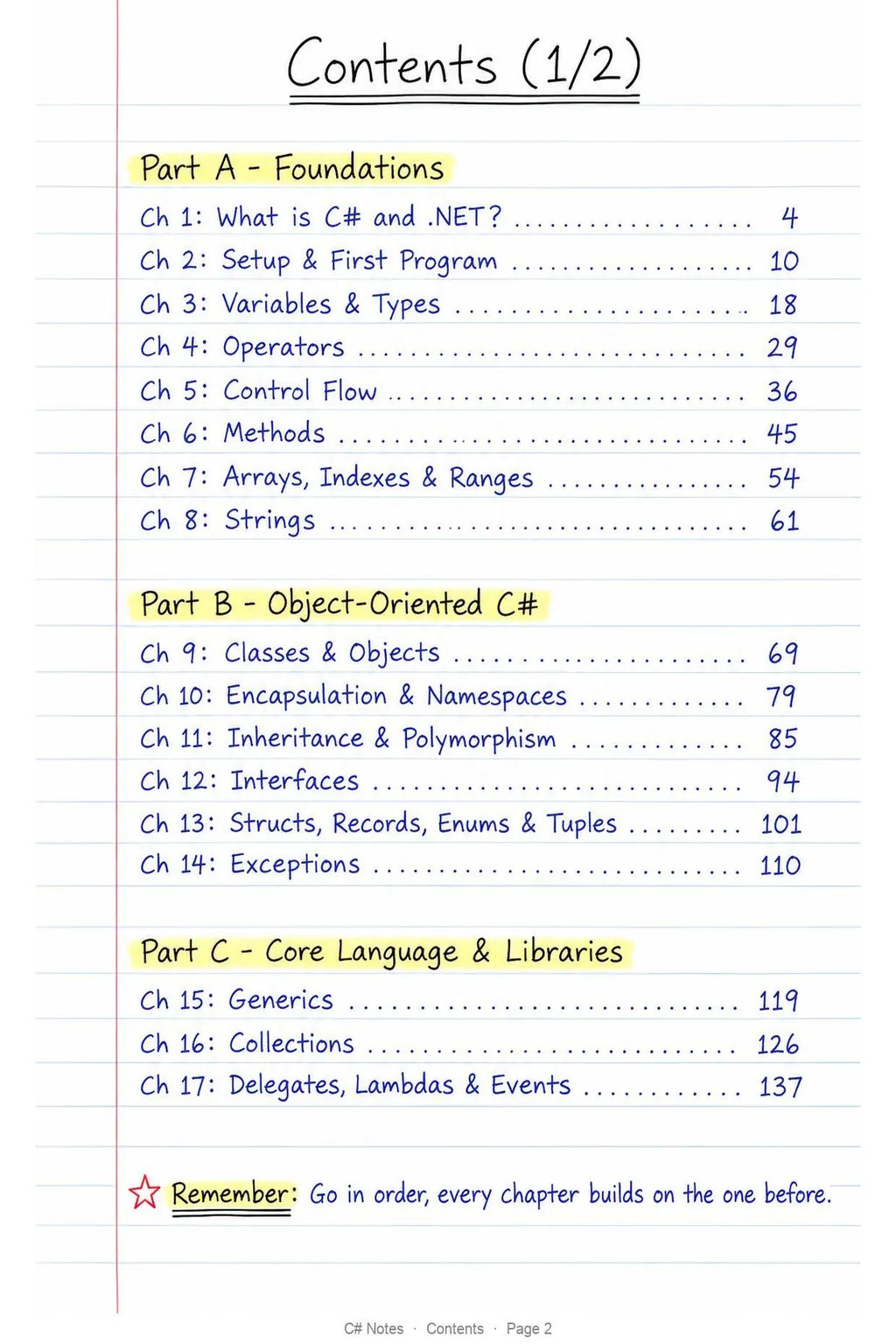
Open any chapter to see every topic it covers and the page it is on.
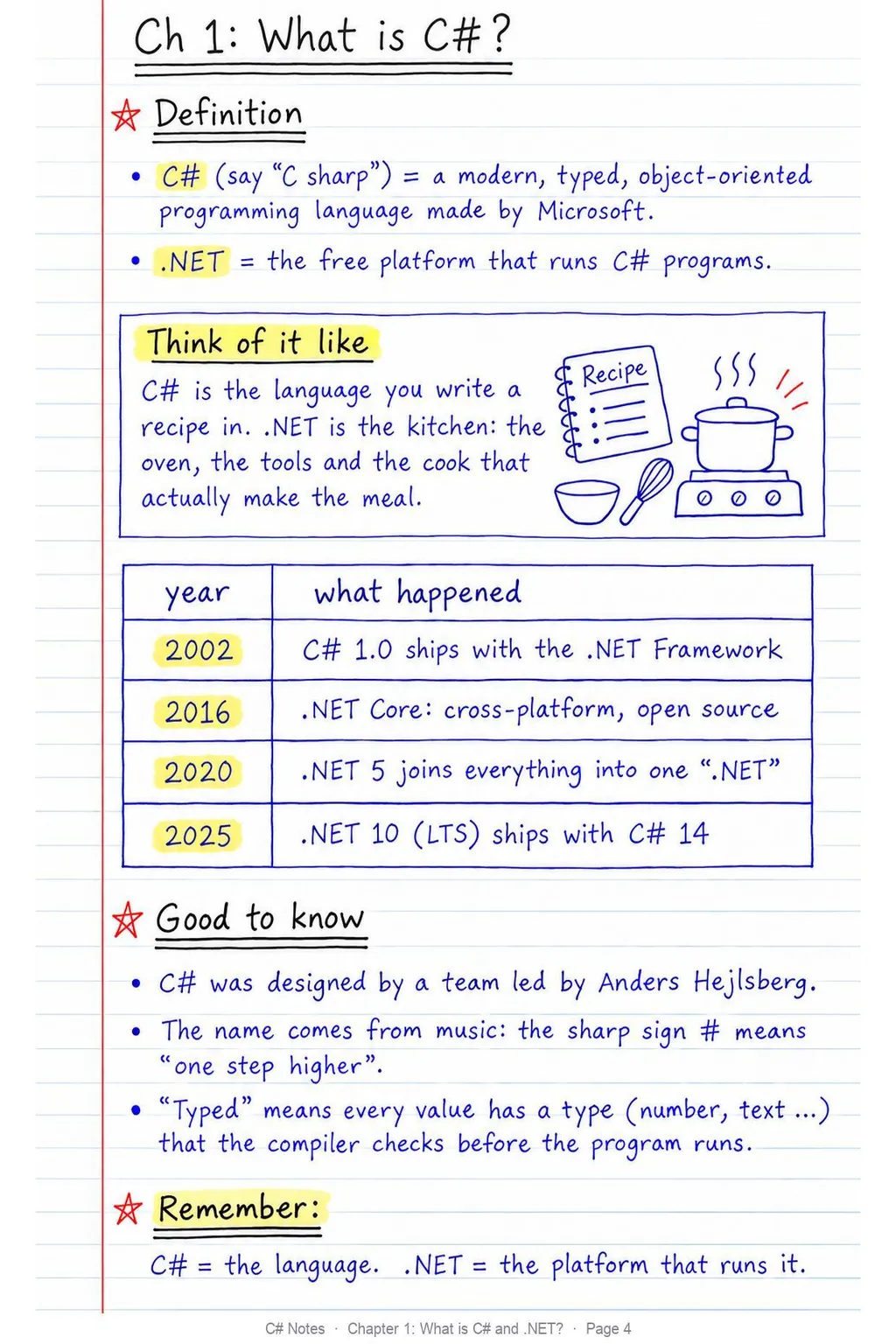
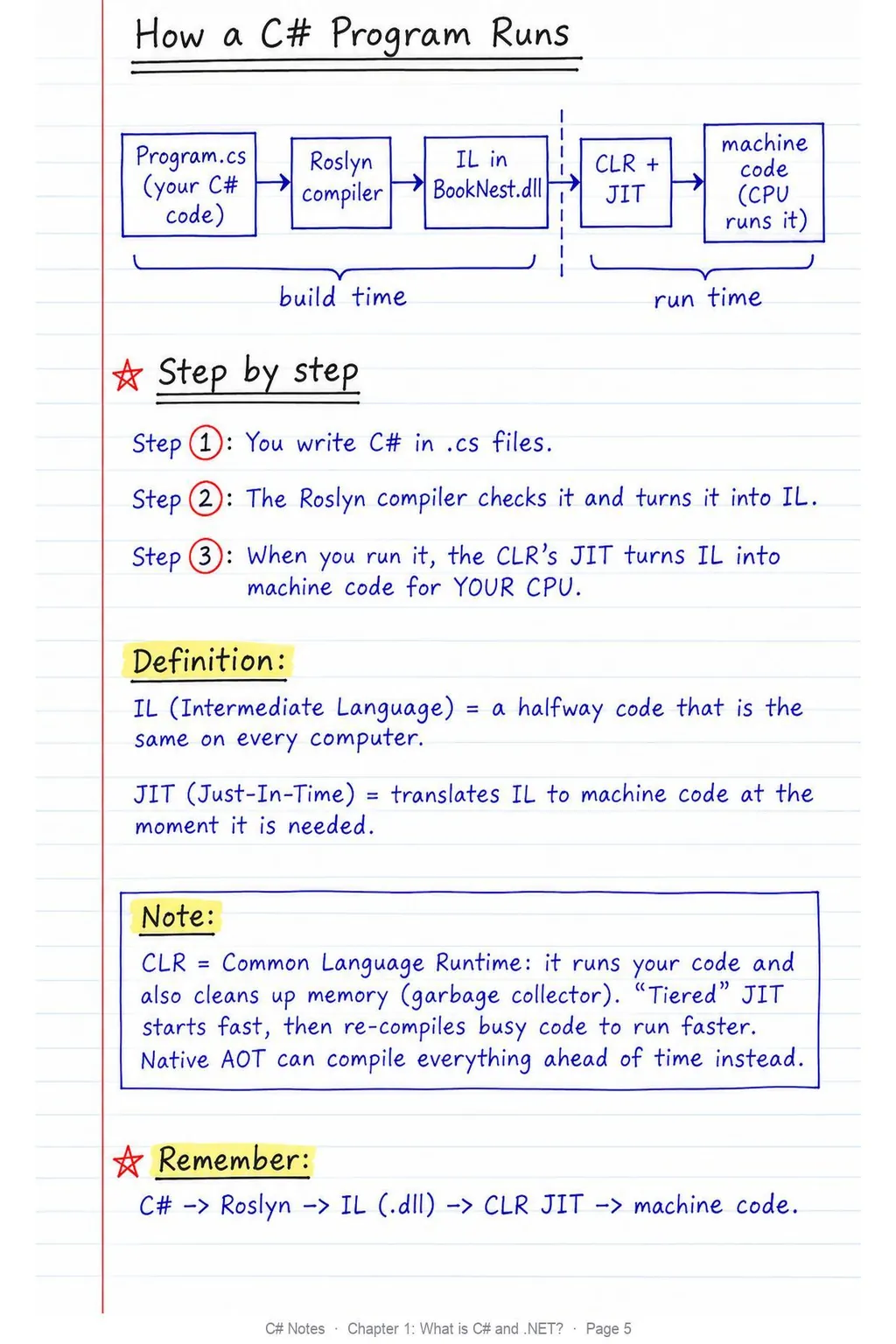
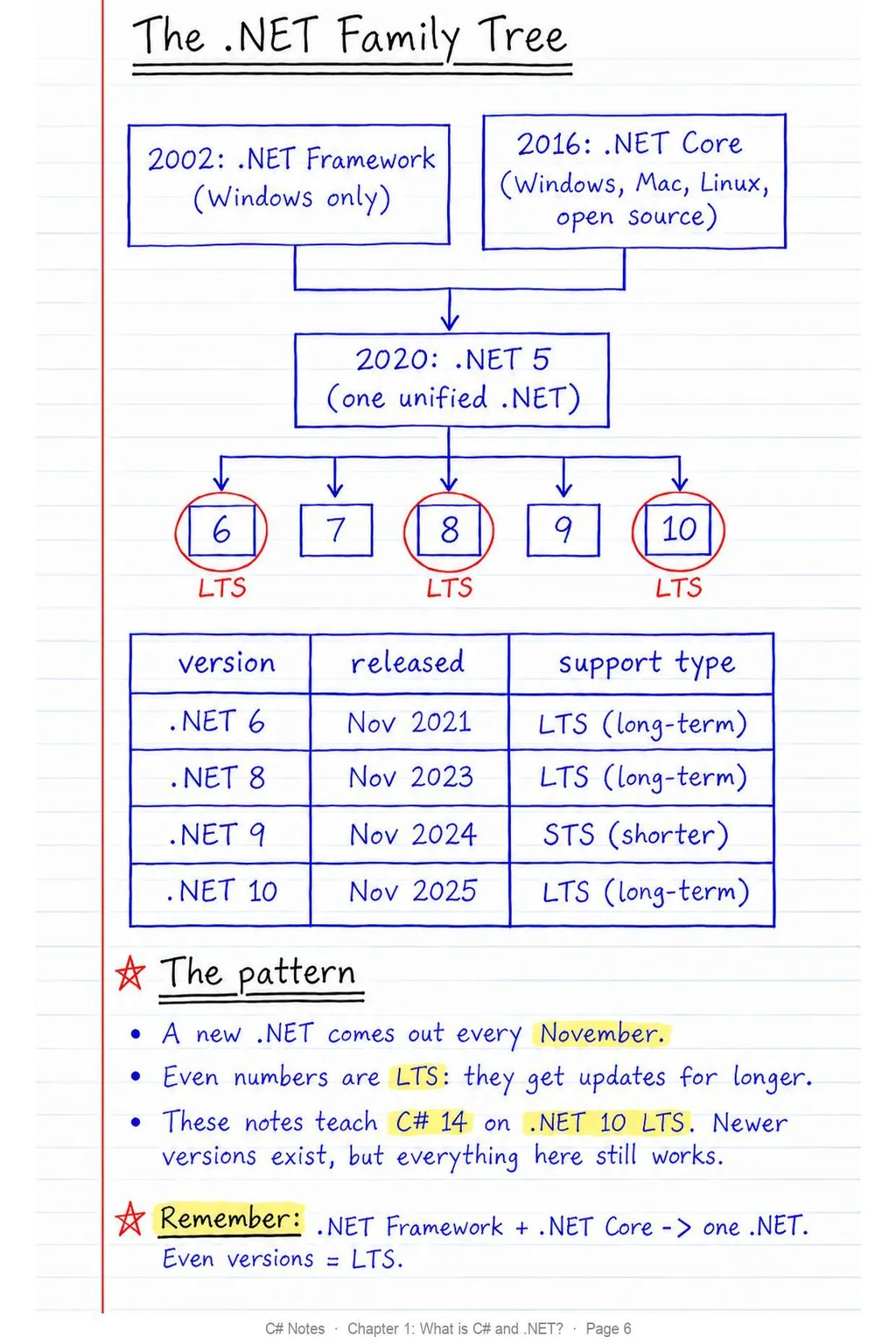
Understand what C# and .NET are: how a C# program runs, the .NET family, where C# is used and how it compares with Java, Python and C++.
Get set up and run your first program: install the .NET SDK, create a project, read Program.cs, top-level statements, dotnet run versus build and publish, file-based apps and naming rules.
Store data with variables and types: numeric and other built-in types, value versus reference types, var, const and readonly, casts, Parse and TryParse, nullable int and double versus decimal.
Work with operators: arithmetic, integer division and %, increment and compound assignment, comparison and logical operators, the null helpers, the ternary operator, operator order and checked.
Control the flow of a program: if and else, switch statements and expressions, while, do-while, for and foreach loops, break, continue, return and safe console input with TryParse.
Write reusable methods: parameters and return values, ref, out and in, optional and named arguments, params, overloading, expression-bodied members, local functions and recursion with the call stack.
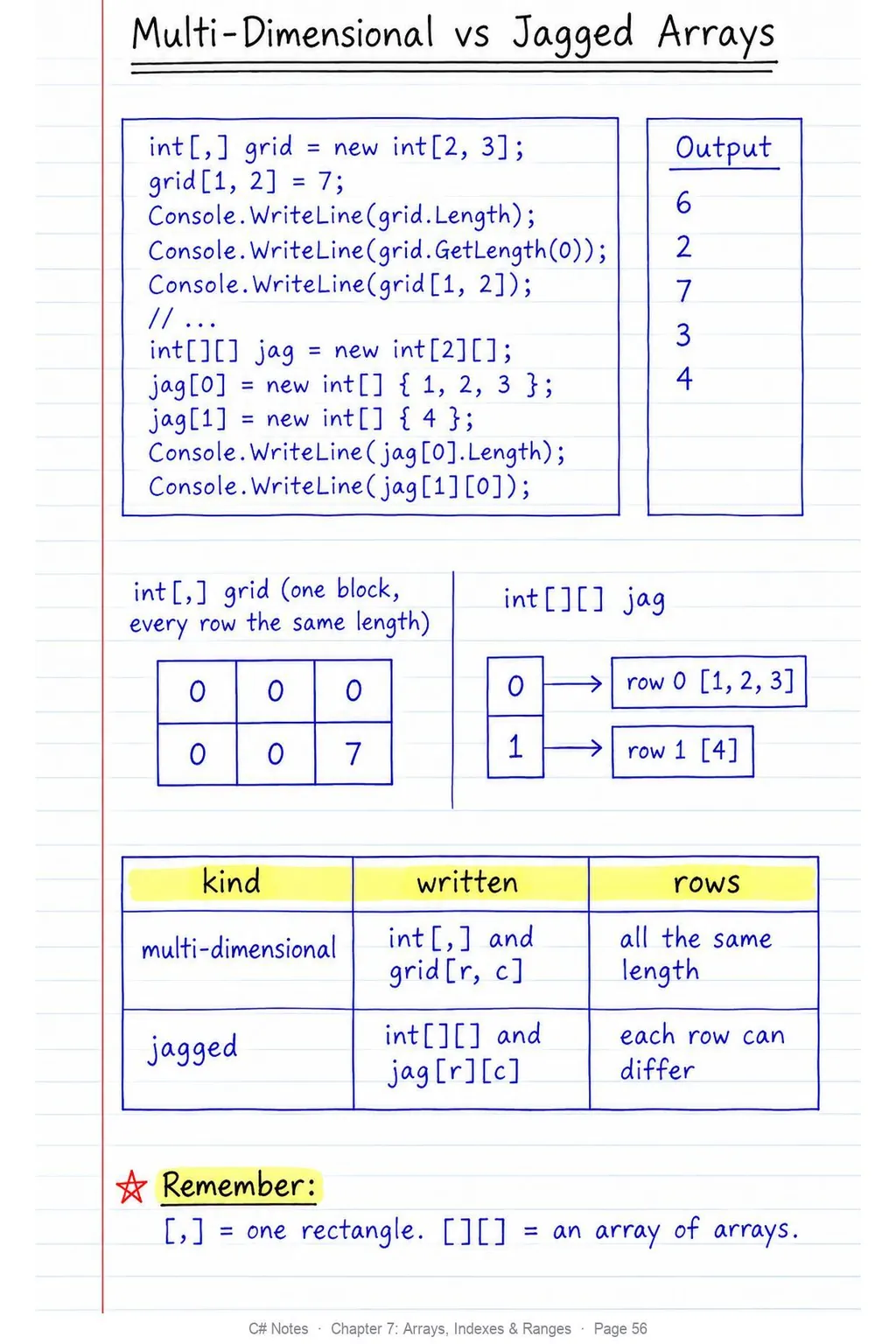
Work with arrays and ranges: looping, sorting and searching, multi-dimensional versus jagged arrays, indices and ranges, collection expressions with spread and a first look at Span of T.
Handle text with strings: immutability, interpolation and format specifiers, escapes, verbatim and raw strings, common methods, StringBuilder, correct comparison, Split, Join and char helpers.
Model things with classes and objects: fields versus properties, auto-properties and init, constructors, object initializers, primary constructors, required members, static members and shared references.
Protect your data with encapsulation: access modifiers, properties with validation, the field keyword, immutability with readonly, init and records, plus namespaces and global usings.
Reuse and specialise code with inheritance: base constructors, virtual and override, polymorphism, abstract classes, sealed and new, System.Object methods and casting with is, as and patterns.
Define contracts with interfaces: implementing several interfaces, default interface methods, common .NET interfaces, explicit implementation and when to pick an interface over an abstract class.
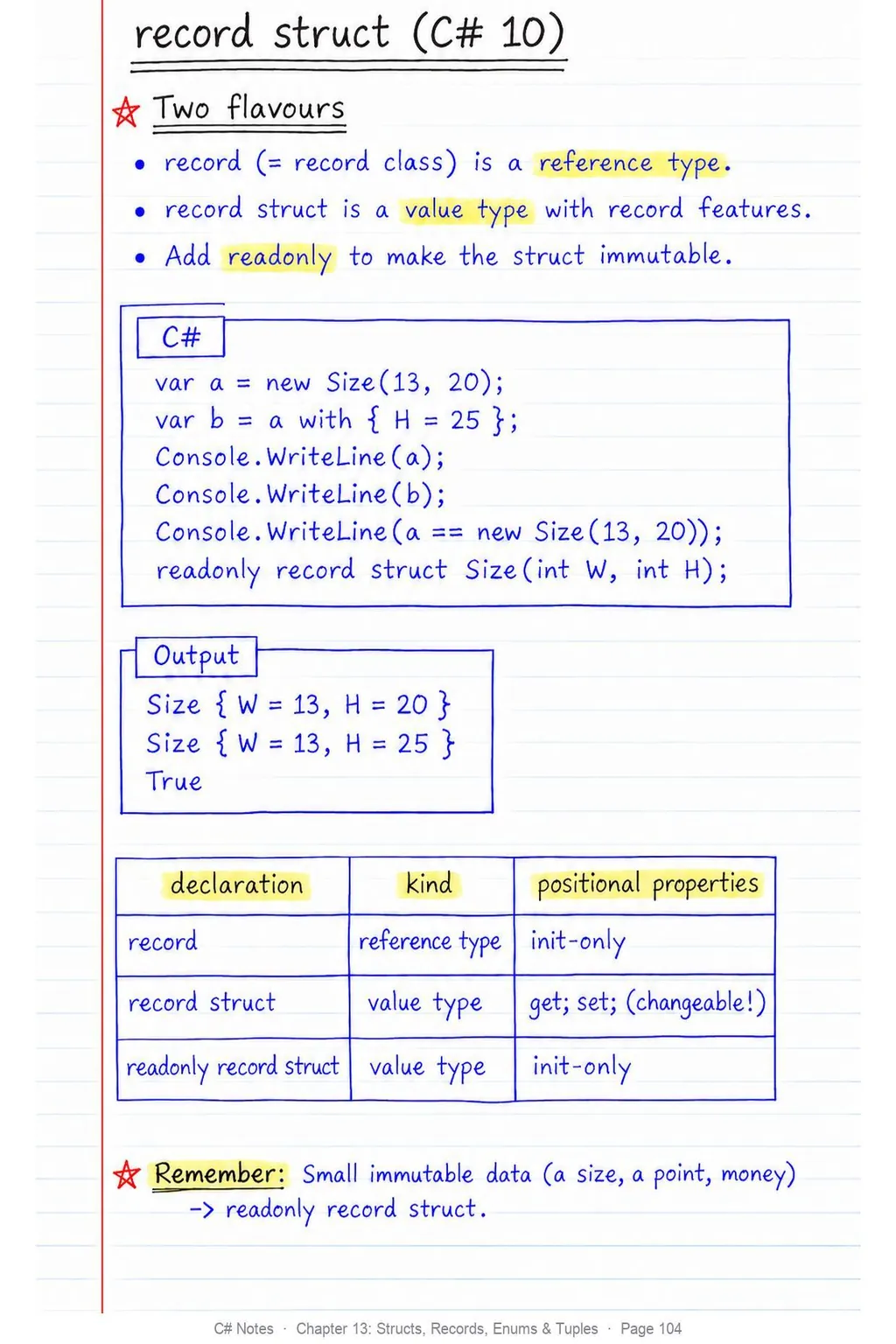
Choose the right data shape: structs versus classes, records and value equality, with-expressions, record struct, enums with switch, Flags enums, tuples and deconstruction, partial and nested classes.
Handle errors with exceptions: the exception hierarchy, try, catch and finally, throw and custom exceptions, filters with when, using and IDisposable, the TryParse pattern and best practices.
Write type-safe reusable code with generics: generic classes and methods, type inference, constraints with where, covariance and contravariance and generic math with INumber of T.
Pick and use the right collection: List, Dictionary and how it finds keys so fast, HashSet, Queue, Stack, PriorityQueue, LinkedList, sorted, immutable and frozen collections and the core interfaces.
Pass behaviour around with delegates: Func, Action and Predicate, lambda syntax, closures, multicast delegates, events with publishers and subscribers and the EventHandler pattern.
Query data with LINQ: method versus query syntax, Where and Select, sorting, First, Single, Any and All, GroupBy, Join, aggregation, SelectMany, Distinct, paging and deferred execution.
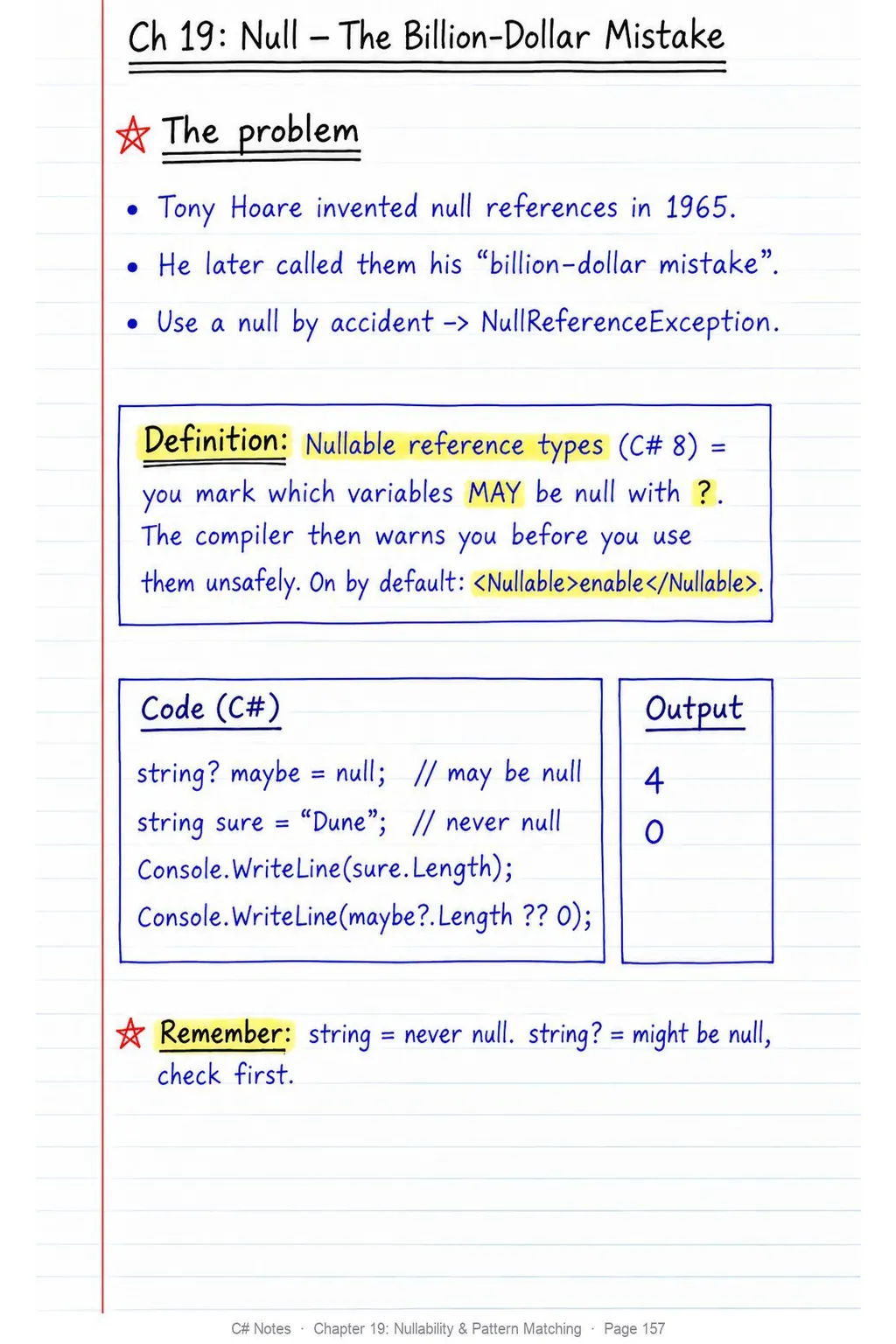
Deal with null and match patterns: null tools, type, declaration, property, relational, logical and list patterns and switch expressions that use them, shown through a late fees example.
Extend what C# can do: extension methods and extension blocks, indexers, operator overloading, iterators with yield return and a timeline of C# versions.
Read and write files, JSON and dates: paths, StreamReader and StreamWriter, System.Text.Json serialising and deserialising, options and attributes, DateTime, DateOnly, TimeOnly, TimeSpan and loan due date maths.
Write asynchronous code: Task and Task of T, async and await step by step, what await really does, WhenAll and WhenAny, cancellation tokens, async streams, exceptions in async code and common pitfalls.
Run work in parallel safely: threads and the thread pool, race conditions, lock, Interlocked, SemaphoreSlim, Parallel.For, ForEach and PLINQ, concurrent collections and channels for producers and consumers.
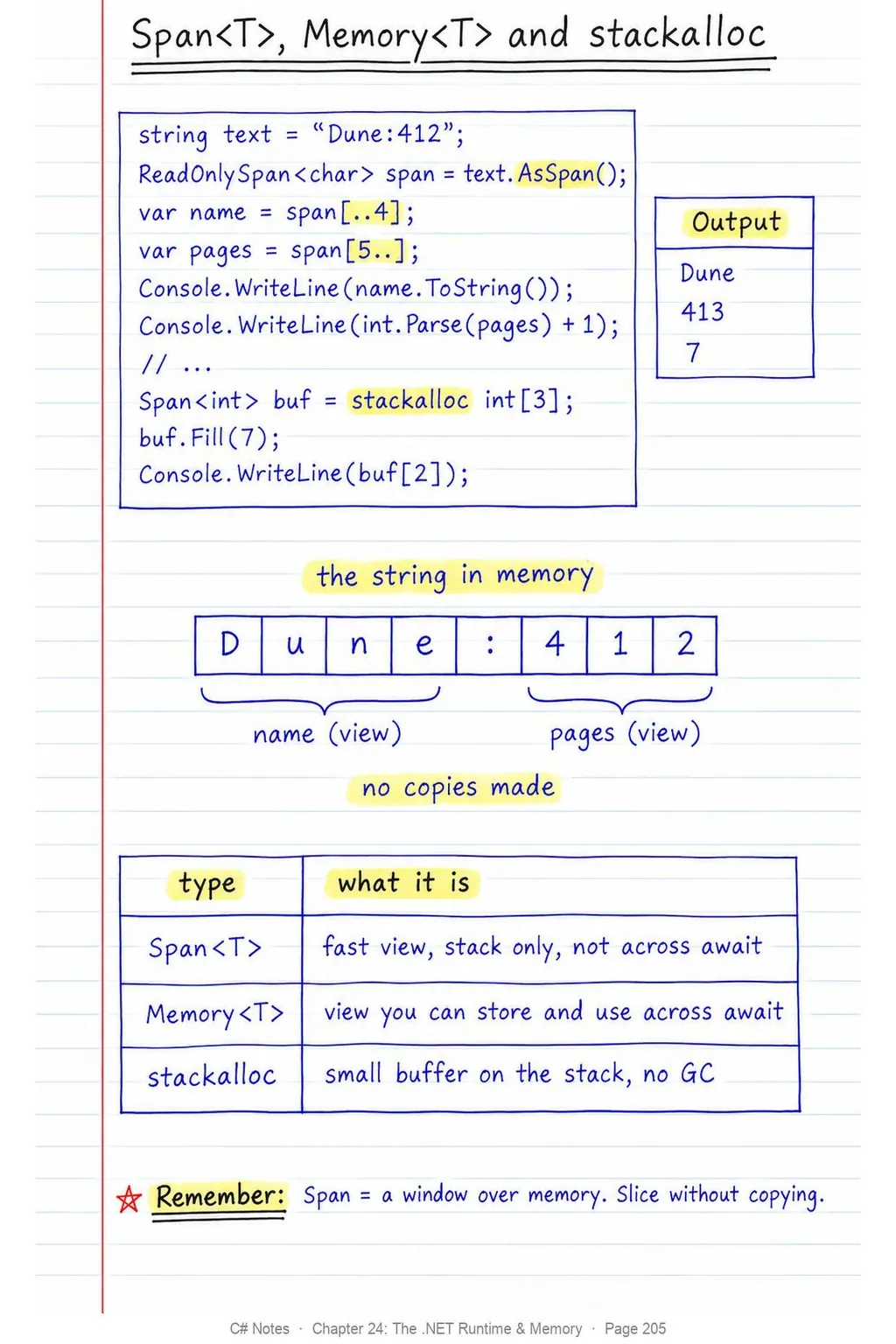
Look inside the .NET runtime: the CLR, IL, JIT and Native AOT, stack, heap and boxing, garbage collection generations, the large object heap, finalizers, Span, Memory, stackalloc and ArrayPool.
Add metadata and generate code: attributes, writing your own attribute, reflection basics, reading attributes with reflection and source generators.
Organise real projects: solutions and projects, the .csproj file, NuGet packages, a dotnet CLI cheat sheet, analyzers, dotnet format and .editorconfig.
Test your code with xUnit: your first test, Theory and InlineData, asserts and Assert.Throws, setup and teardown, mocking with Moq and testing async code.
Build web APIs with ASP.NET Core Minimal APIs: routes and constraints, JSON and status codes, POST bodies, dependency injection and lifetimes, middleware, configuration, logging, route groups, validation and OpenAPI.
Talk to a database with Entity Framework Core: entities, DbContext, migrations, create, read, update and delete, how LINQ becomes SQL, relationships with Include, tracking and the N+1 problem.
Design cleaner code with SOLID and patterns: the five SOLID principles with dependency injection, then Singleton, Factory, Strategy, Observer, Repository and the Options pattern.
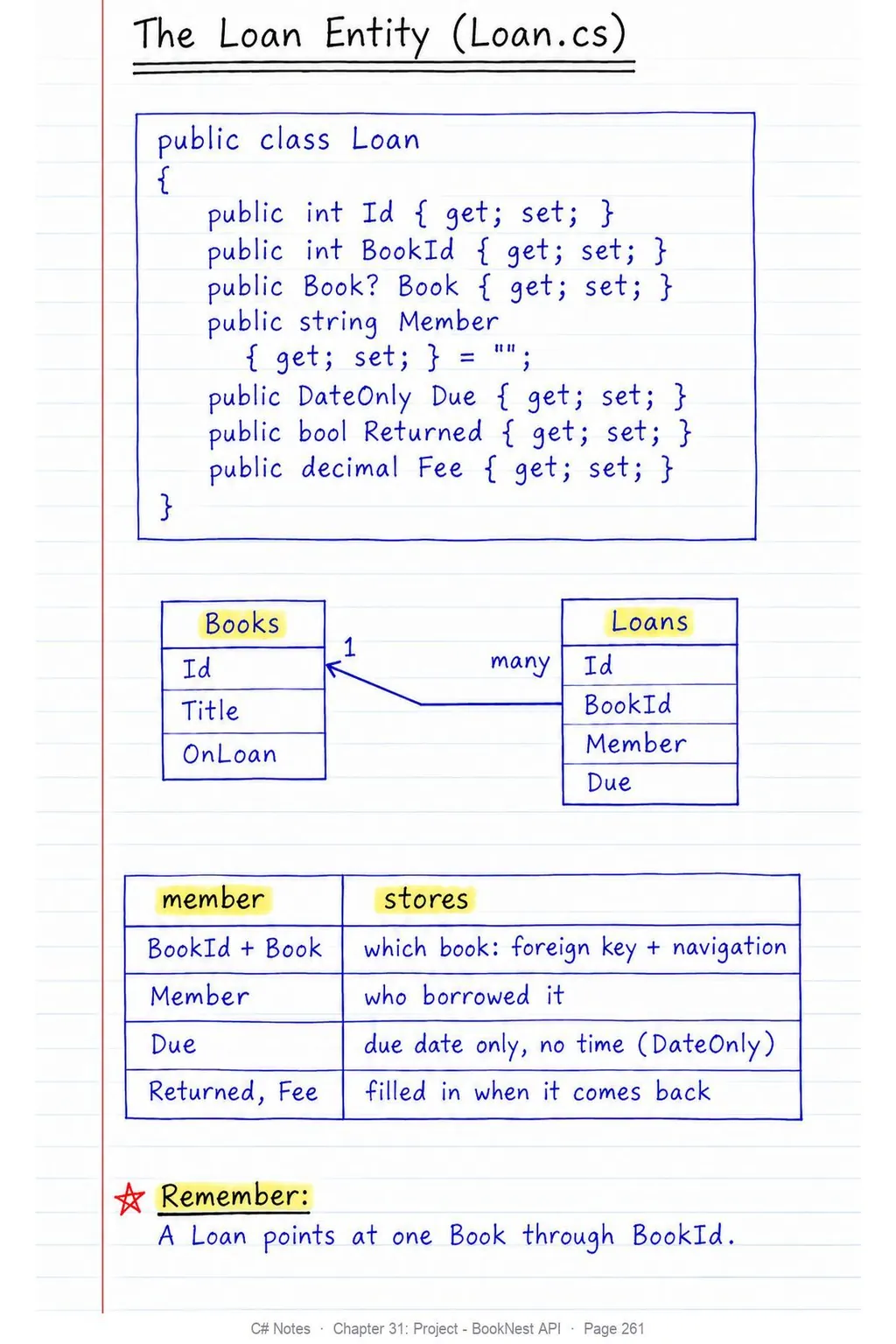
Build the BookNest API from scratch: entities, DbContext, Program.cs, GET, POST, borrow and return endpoints, late fee rules, ProblemDetails, migrations, seed data, unit tests and a run checklist.
Make your code faster and cleaner: measuring with BenchmarkDotNet, fewer allocations with Span and avoiding boxing, async best practices, Native AOT, trimming and a list of top best practices.
Survey the wider .NET ecosystem: an ecosystem map, Blazor for web UI in C#, .NET MAUI for apps on many devices and Unity for game scripting.
Prepare for interviews and plan your next steps: Q&A on runtime, types, strings, OOP, LINQ, async, memory, web and data, cheat sheets, the top 10 mistakes and a learning roadmap.
Watch before you buy
Students on All Notes PDF
Real students talking about how they revise with our handwritten notes.
How it works
Get your notes in 3 easy steps
No app, no waiting. The whole thing takes under a minute.
- STEP 110 sec
Choose your notes
One subject, any two, or a full class set.
- STEP 230 sec
Pay with UPI or card
GPay, PhonePe, Paytm or card. Pay once, no subscription.
- STEP 3Instant
Download your PDFs
Tap Download on any chapter. Links never expire.
- Log in
- My library
- Download
What you get
- Format
- Downloadable PDF (not a printed book)
- Chapters
- 34 chapters in one 297 page PDF
- Level
- C# from beginner to advanced. No experience needed
- Style
- Handwritten-style notes with diagrams, code explained line by line, common mistakes and quizzes
- Devices
- Phone, tablet and laptop. Print any chapter if you like
- Access
- Lifetime. Download again anytime from My library
- Instant downloadRight after payment
- Free updatesCorrections added free
- Secure paymentUPI, cards, net banking