Tech · Beginner to Advanced · Handwritten PDF notes
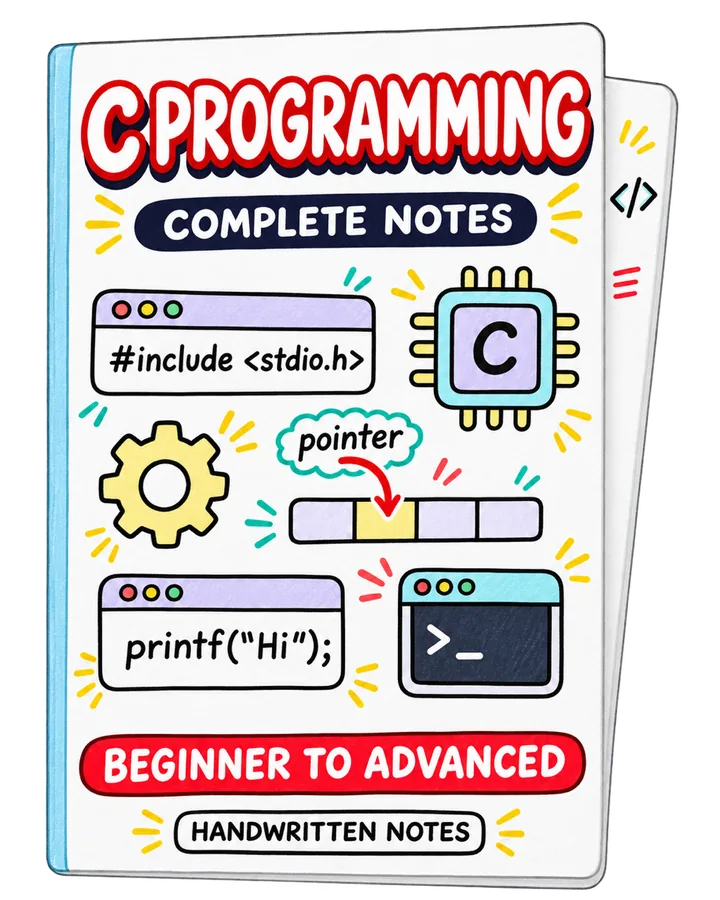
C Programming Complete Notes
Instant PDF download after payment. Pay once, keep forever.
- Instant download
- Lifetime access
- UPI, GPay, PhonePe, cards
Complete coverage
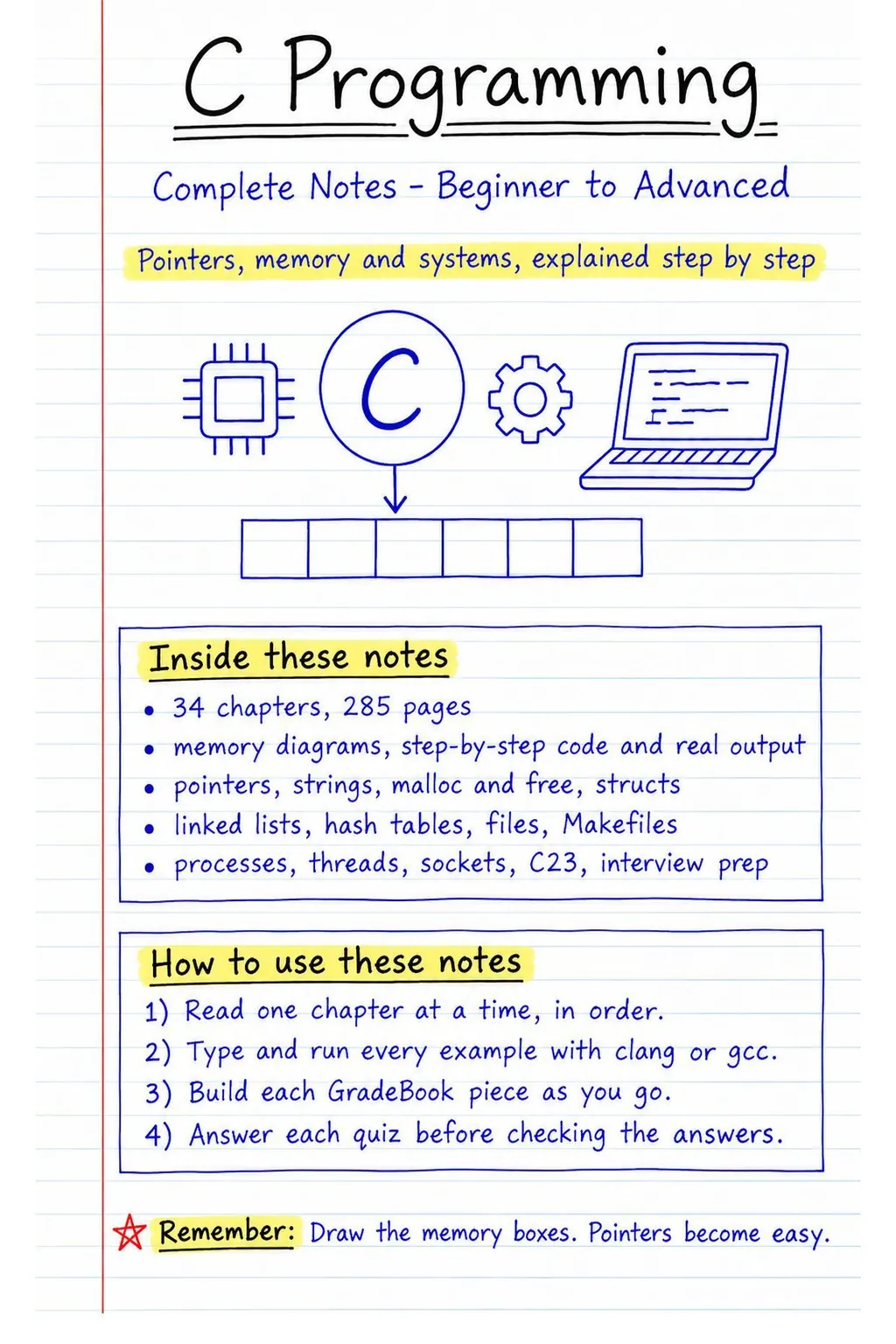
What you learn in all 34 chapters
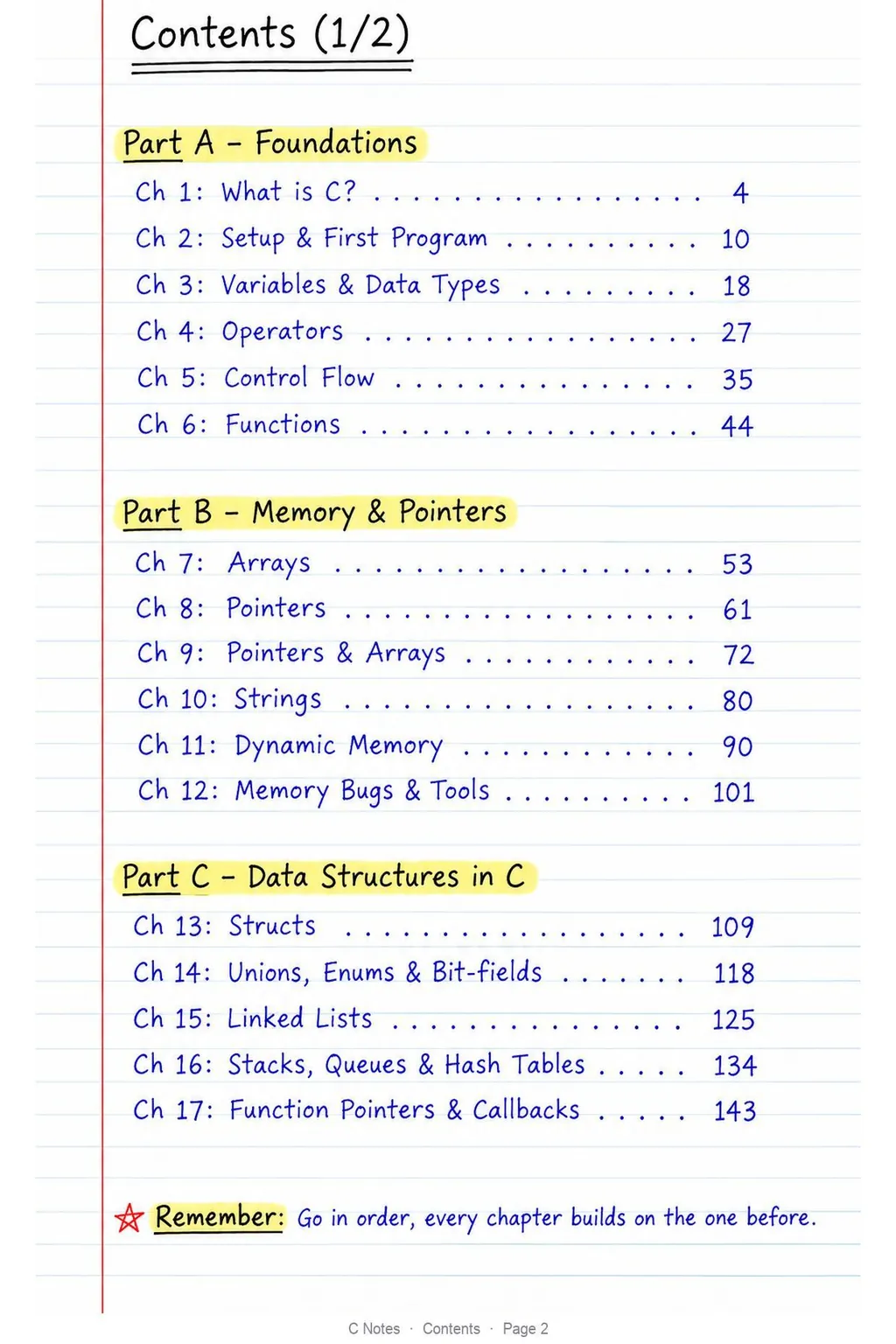
Open any chapter to see every topic it covers and the page it is on.
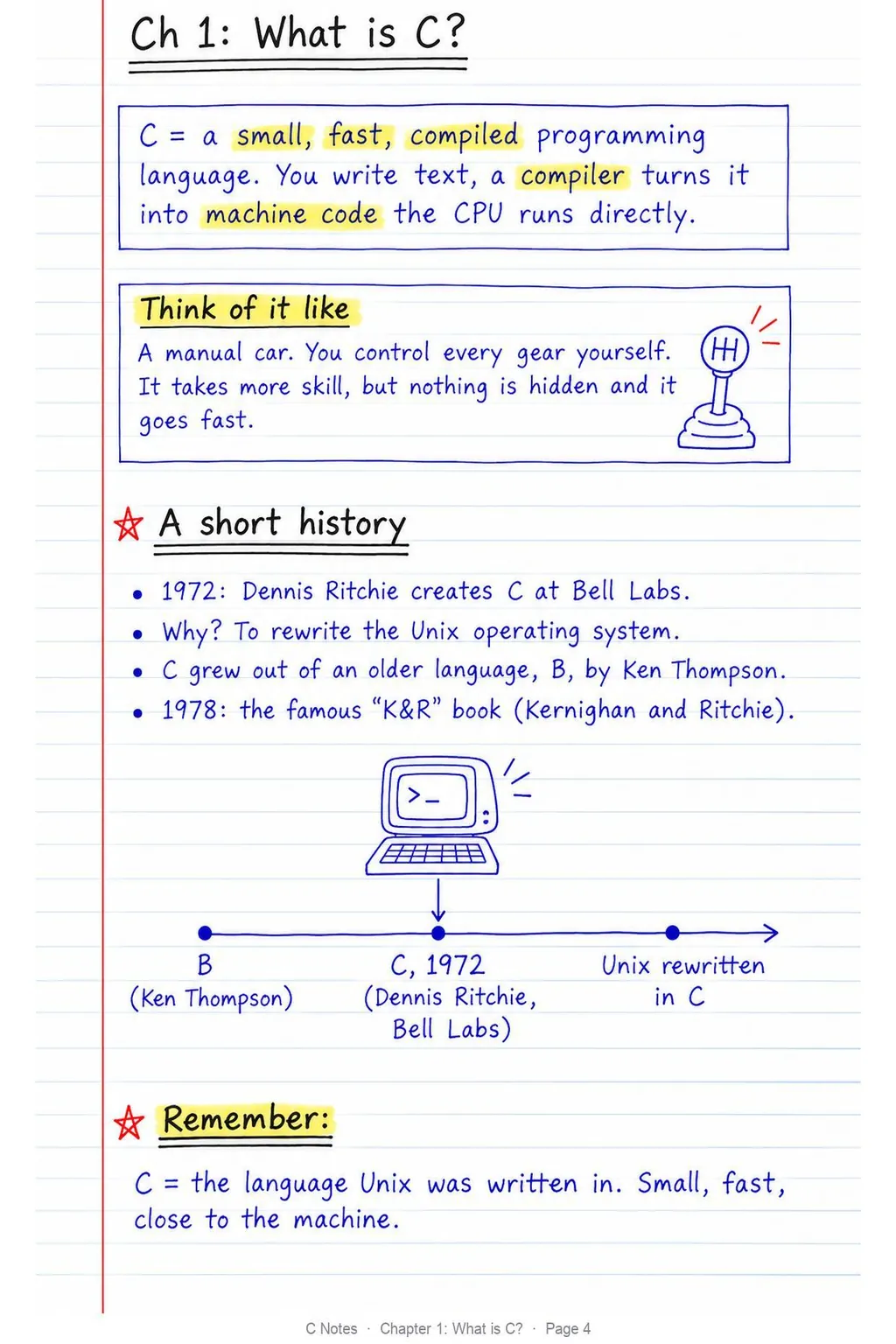
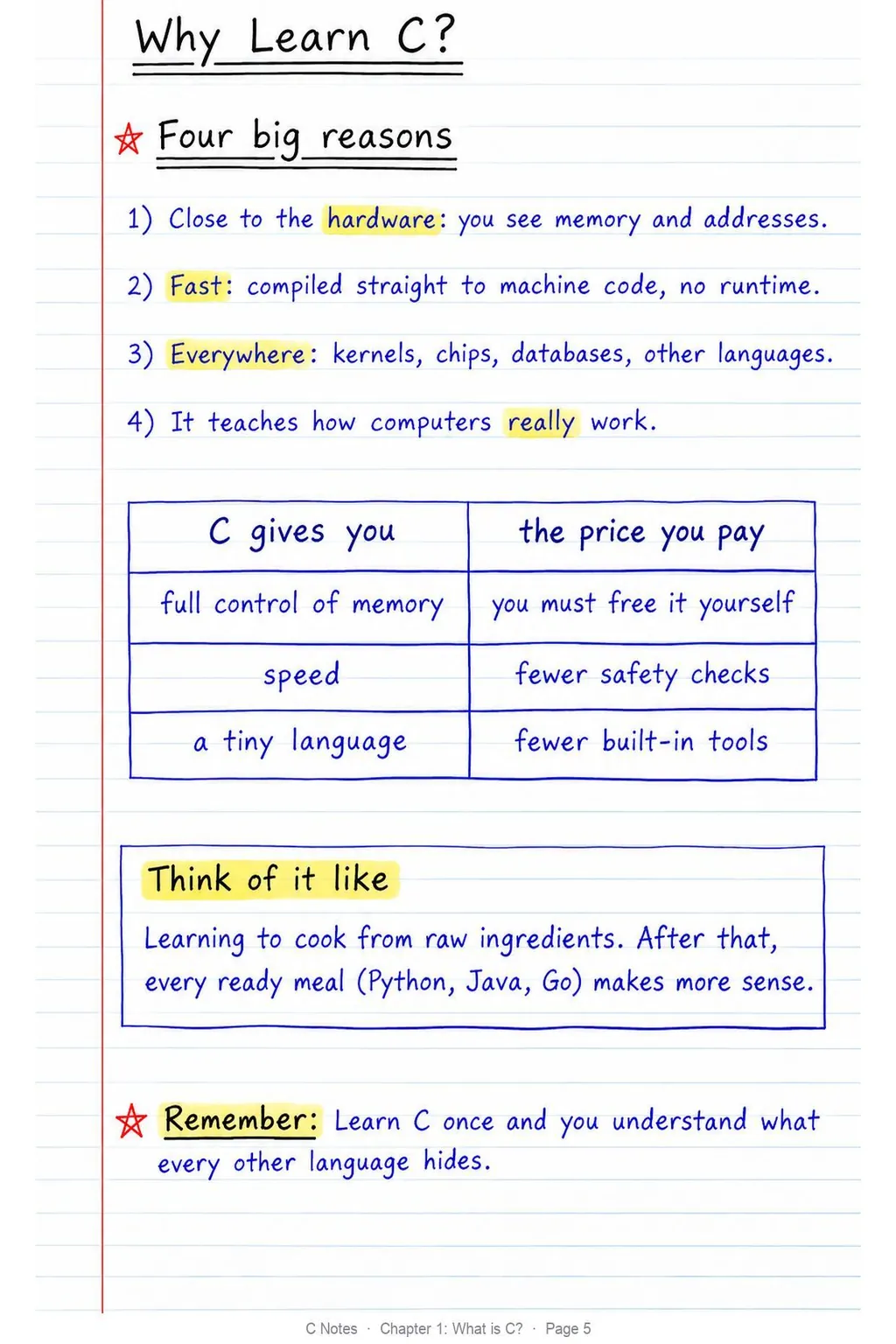
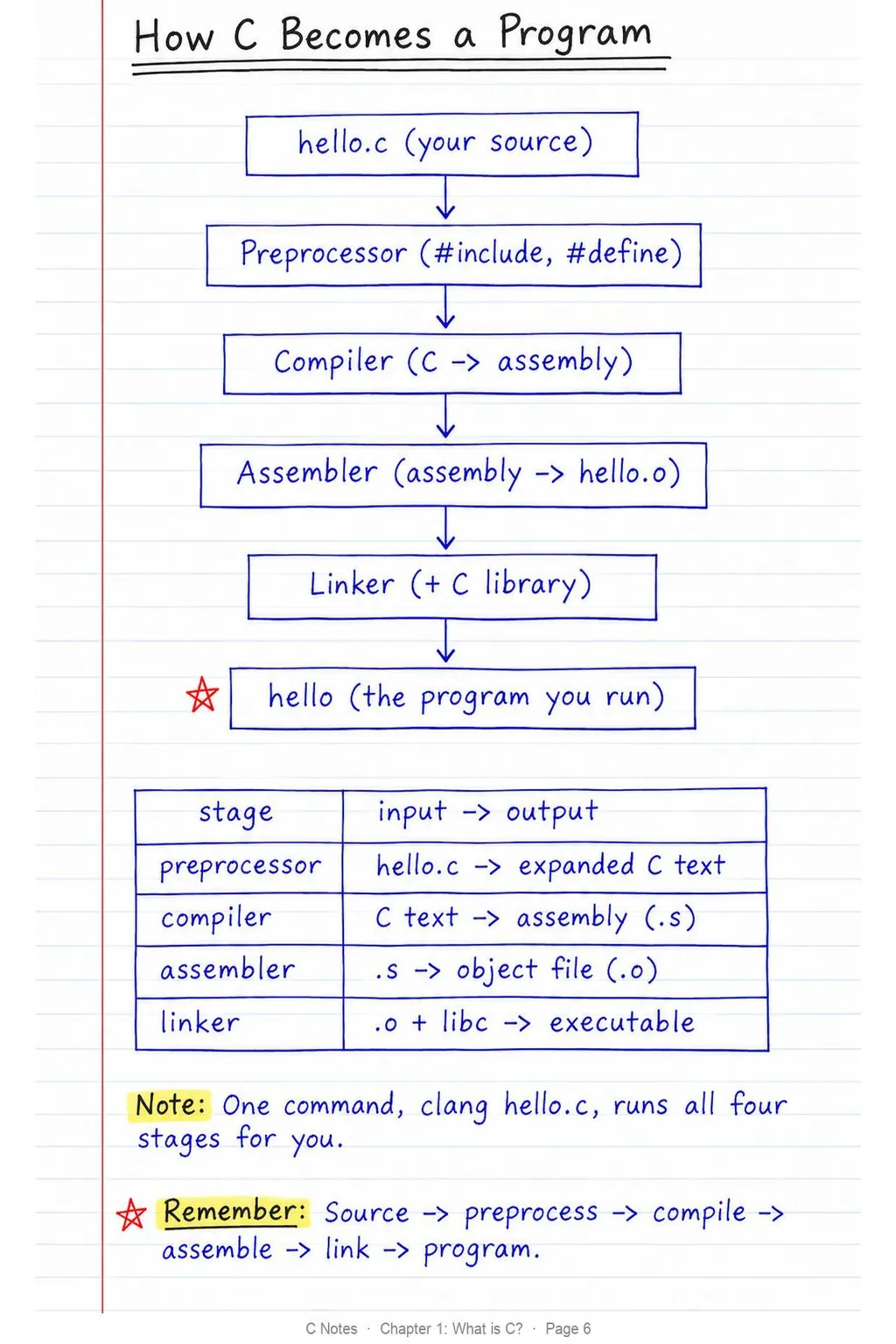
Understand what C is and why it still matters: why learn it, how C source becomes a program, where C is used, and how it compares with C++, Rust and Python.
Set up a compiler and run your first program: hello.c line by line, compiling and running, compiler warnings, the four build stages, printf and escape sequences, comments, style and naming.
Store data in variables: named memory boxes, basic types and sizeof, printf format specifiers, signed versus unsigned ranges, fixed-width types and size_t, constants, bool, char as a number and reading input with scanf.
Work with operators: arithmetic, integer division and %, prefix versus postfix ++ and --, compound assignment, comparison and logical operators, type conversion and casts, overflow behaviour and precedence.
Control the flow of a program: if and else chains, the = versus == bug, switch and fallthrough, while, do-while, for, break and continue, and nested loops that print patterns.
Break code into functions: anatomy, prototypes versus definitions, pass by value, return values and void, local versus global scope, static locals, the call stack and recursion.
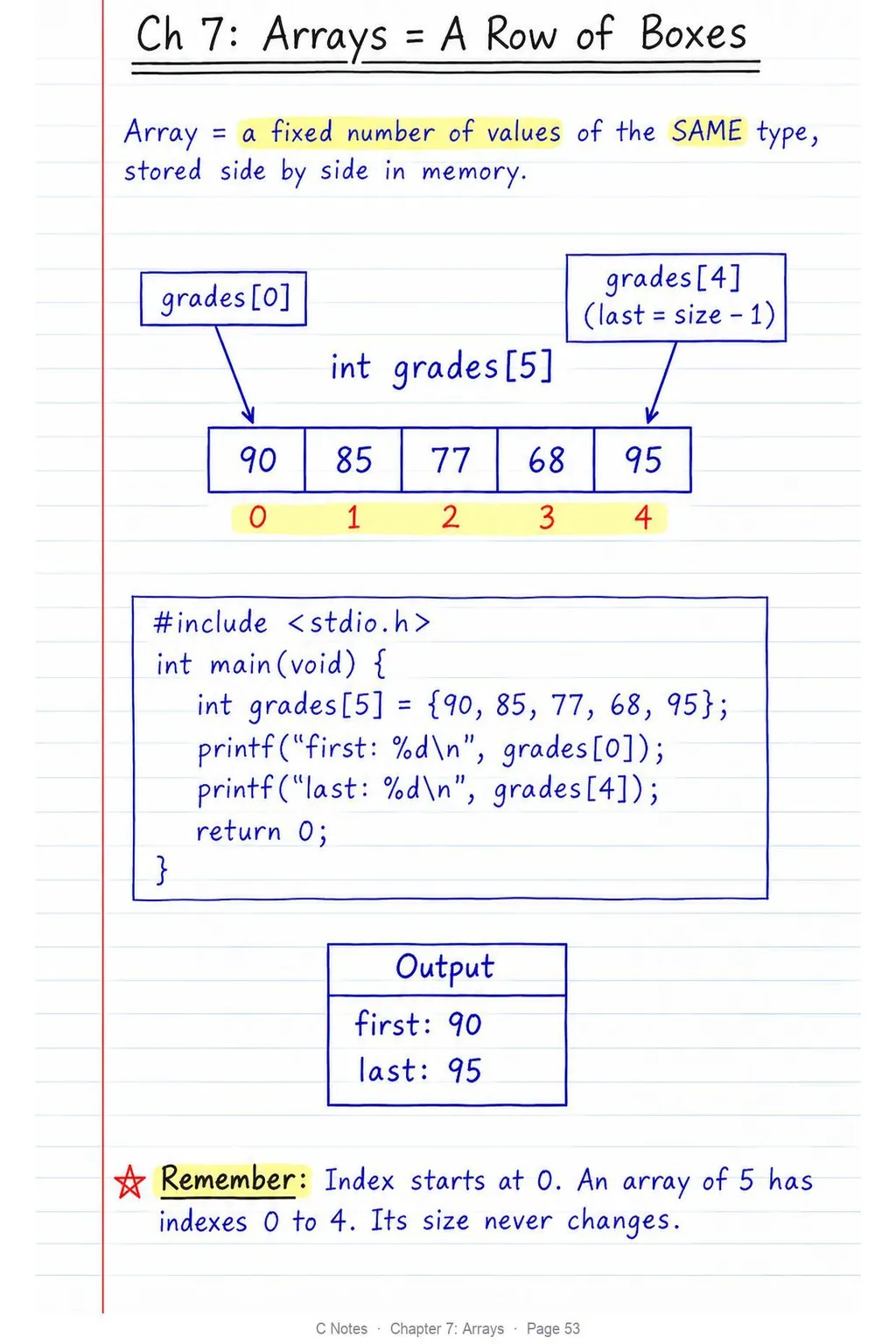
Store lists of values in arrays: initializing and counting elements, looping to compute an average, why there is no bounds checking, passing arrays to functions, 2D arrays, searching and bubble sort.
Understand pointers: memory addresses, the & operator, pointer variables, dereferencing, pass by pointer with swap, NULL checks, pointer to pointer, const with pointers, void * and common pointer bugs.
See how pointers and arrays connect: array names decaying to pointers, pointer arithmetic, p[i] versus *(p + i), walking an array, pointer difference and comparison, why they differ and returning pointers safely.
Handle text in C: strings as char arrays ending in '\0', literals versus arrays, printing and reading with fgets, strlen, strcpy, strncpy, snprintf, strcat, strcmp, strchr, strstr, ctype.h and strtol.
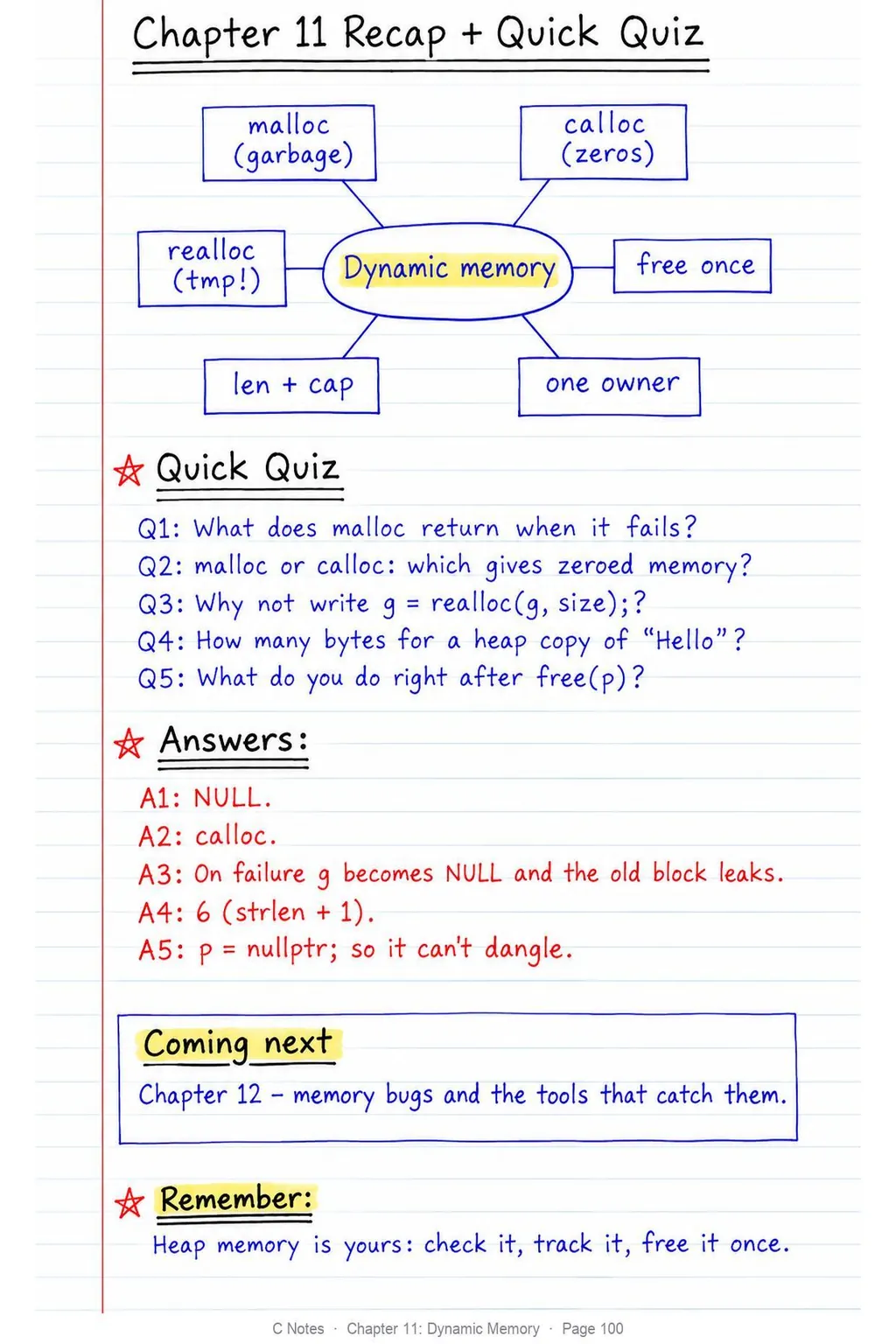
Manage memory by hand: stack versus heap, malloc with sizeof and NULL checks, free, calloc, realloc, growing dynamic arrays, heap strings, 2D dynamic arrays and the ownership rule of who frees.
Find and prevent memory bugs: the five classic mistakes, leaks, use-after-free and dangling pointers, buffer overflows, AddressSanitizer, valgrind and leaks, and a checklist of defensive habits.
Group related data with structs: fields, creating and initializing, . versus ->, typedef, arrays of structs, passing by value or by pointer, nested structs, padding and alignment.
Model data with enums, unions and more: named integer constants, enums in a switch as a state machine, unions that share memory, tagged unions, bit-fields for flags and flexible array members.
Build linked lists from scratch: why use them, the self-referential node struct, creating nodes with malloc, walking, inserting at head and tail, deleting by relinking, freeing the list and doubly linked lists.
Build core data structures: stacks with arrays and linked lists, a circular buffer queue, hash tables with a djb2 hash and chaining, binary search trees and a Big-O cheat sheet.
Use function pointers: functions have addresses, declaring and calling them, typedef for readability, callbacks, qsort with a comparator and dispatch tables built from arrays of function pointers.
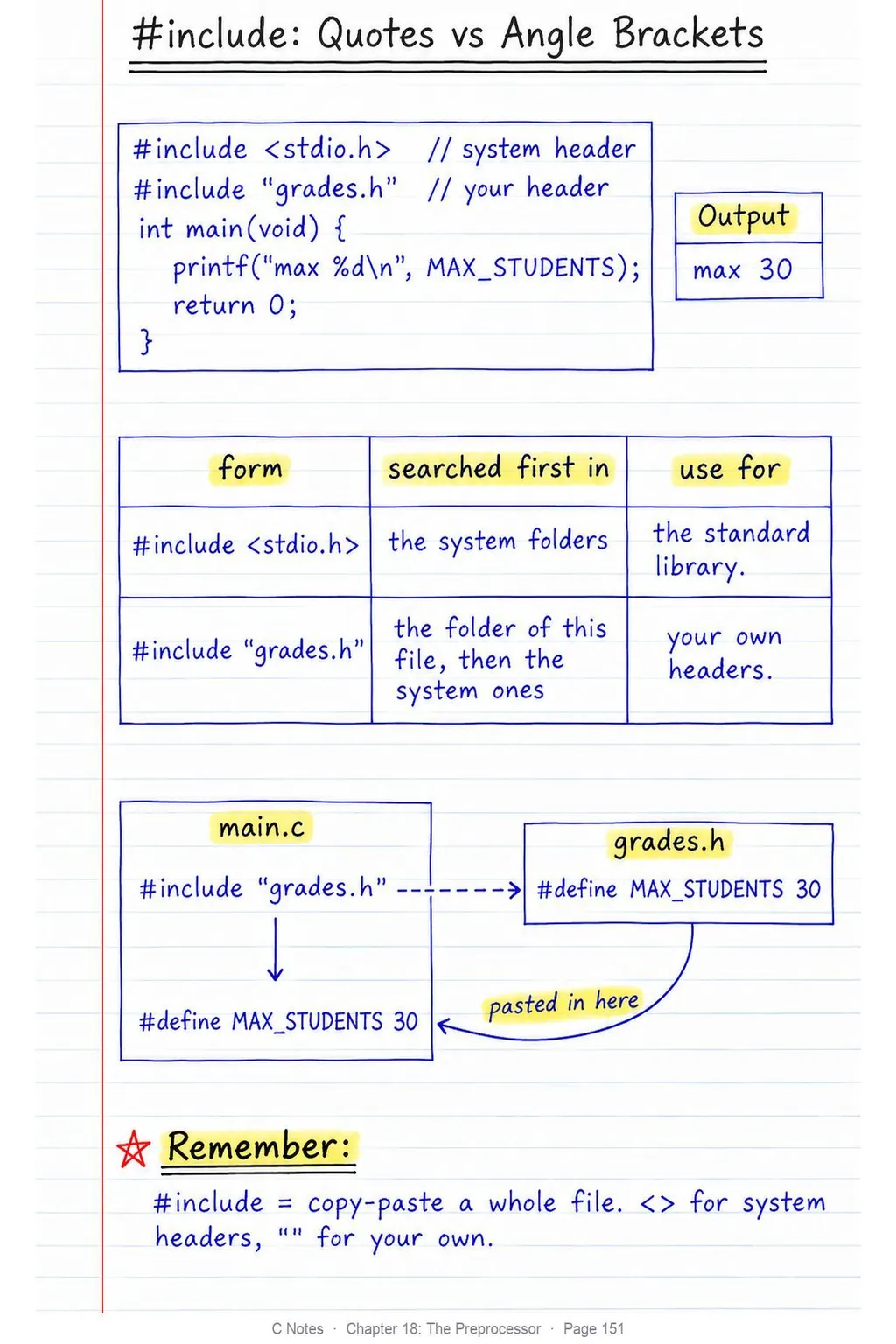
Control what the compiler sees with the preprocessor: #include forms, #define constants, function-like macros and the parentheses trap, #ifdef DEBUG, include guards, #pragma once, __FILE__, __LINE__, __func__ and assert.
Split a program across files: headers versus .c files, compiling and linking several files, extern for shared globals, static for file-private functions, storage classes, scope versus lifetime and linker errors.
Understand builds and Makefiles: the build stages file by file, object files and the linker, static versus shared libraries, why make rebuilds only what changed, variables, pattern rules, debug versus release builds and CMake.
Read and write files: streams and FILE *, fopen modes and NULL checks, fprintf and fputs, fgets, fscanf and sscanf, fgetc and EOF, binary files with fwrite and fread, and fseek, ftell and rewind.
Handle errors without exceptions: return codes, errno, perror and strerror, checking every call that can fail, the goto cleanup pattern, exit codes and stderr, and assert versus runtime checks.
Manipulate individual bits: a binary and hex refresher, the operators & | ^ ~, shifts, setting, clearing, toggling and testing a bit, packing many flags in one number and tricks like power of two and counting 1s.
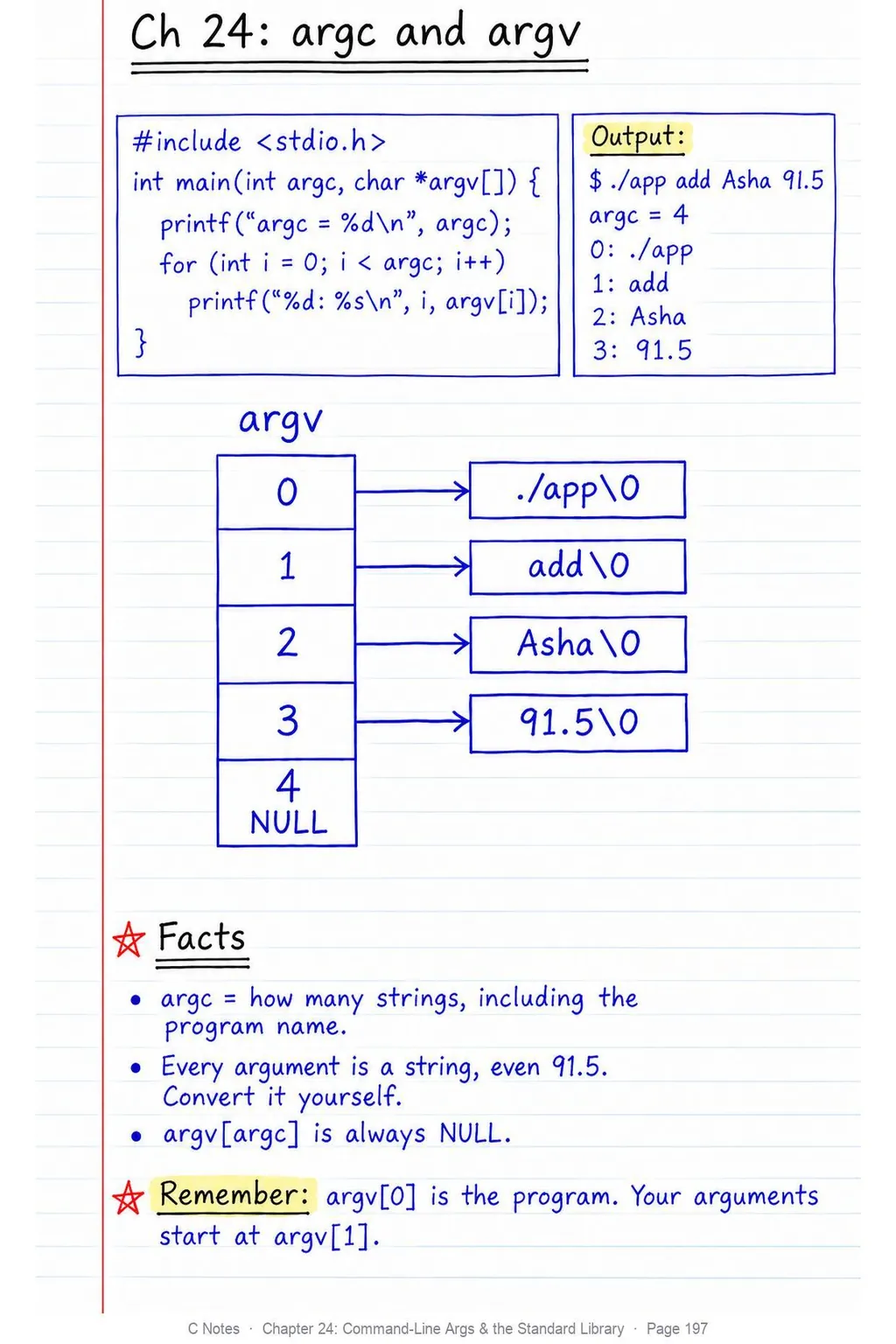
Use command-line arguments and the standard library: argc and argv, safe number parsing with strtol, a tour of <stdlib.h>, rand and srand, dates and timing with <time.h>, and sqrt, pow and friends from <math.h>.
See how a process uses memory: the five segments, where each variable lives, stack frames growing down, heap blocks coming and going, stack overflow and virtual memory giving each process its own map.
Work with processes and system calls: program versus process, system calls versus library calls, file descriptors 0, 1 and 2 with write(), fork, exec, wait and exit status, and pipes between processes.
Run code in parallel with pthreads: processes versus threads, pthread_create and pthread_join, passing data in and out, race conditions, mutexes, deadlock, C11 threads.h and atomics.
Talk over the network with sockets: client, server and TCP, the server steps of socket, bind, listen and accept, client connect, send and recv, a tiny echo server, byte order with htons and error checks.
Write modern C: a timeline of C versions, C99 essentials, C11 _Generic and static assertions, and C23 features including bool, nullptr, constexpr, auto, typeof, attributes, binary literals, digit separators and #embed.
Write safer C by understanding undefined behavior: what it means, common causes, sanitizers that catch it, how buffer overflow attacks work, the format string bug, integer overflow in size calculations and a safe C checklist.
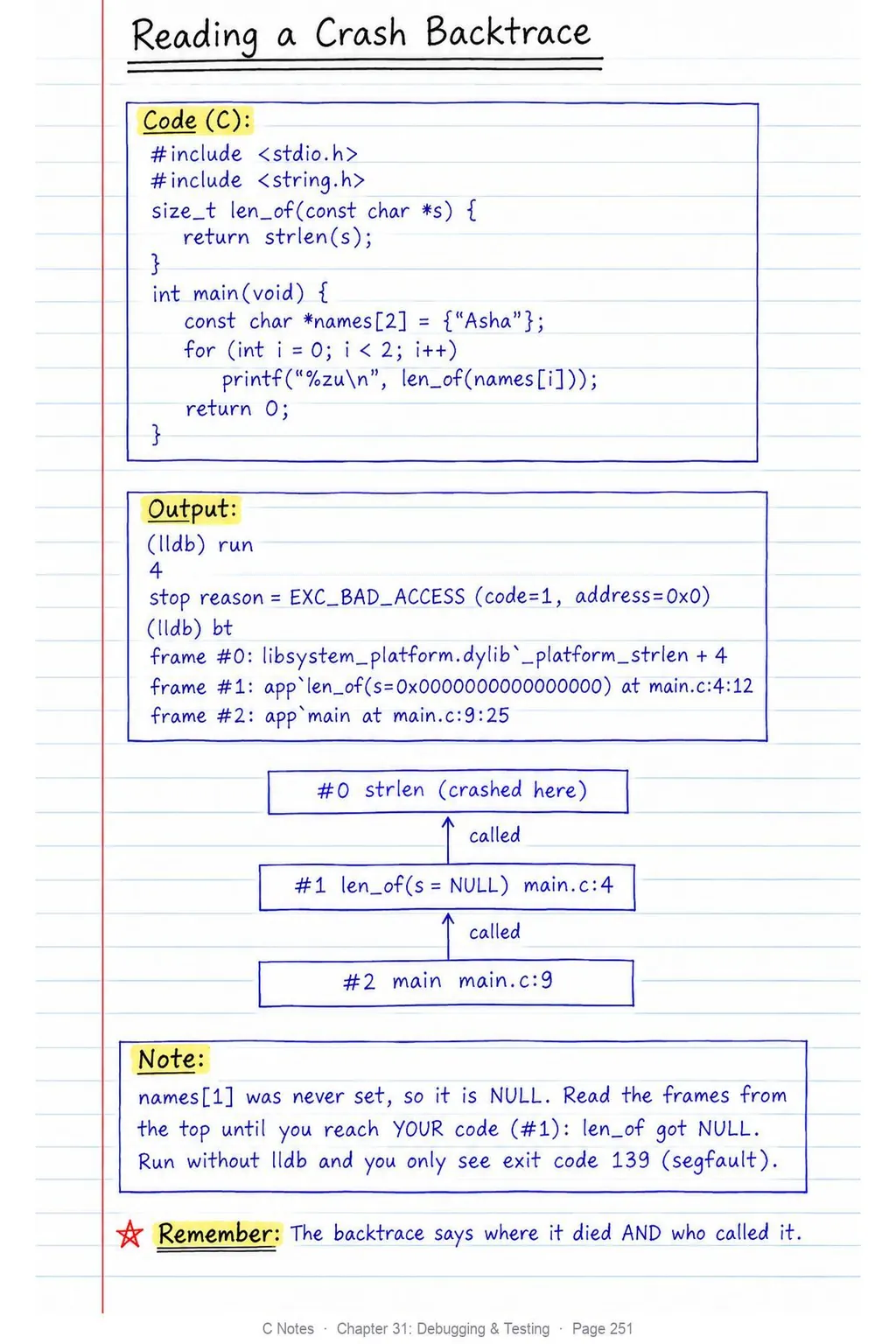
Debug and test your programs: printf debugging and stderr, lldb and gdb basics, reading a crash backtrace, unit tests with assert, a tiny CHECK test harness and static analysis that finds bugs without running code.
Build a complete GradeBook CLI project: file layout, student.h and student.c, listing and averages, sorting with qsort, CSV save and load, the add command in main.c, a Makefile, unit tests and a clean ASan run.
See where C runs in the real world: embedded C with registers and volatile, calling C from other languages through FFI, and how C compares with C++.
Prepare for interviews and plan what comes next: Q&A on pointers, memory, static, volatile, const, structs, UB and systems, cheat sheets, the top 10 mistakes, a learning roadmap and memory on one page.
Watch before you buy
Students on All Notes PDF
Real students talking about how they revise with our handwritten notes.
How it works
Get your notes in 3 easy steps
No app, no waiting. The whole thing takes under a minute.
- STEP 110 sec
Choose your notes
One subject, any two, or a full class set.
- STEP 230 sec
Pay with UPI or card
GPay, PhonePe, Paytm or card. Pay once, no subscription.
- STEP 3Instant
Download your PDFs
Tap Download on any chapter. Links never expire.
- Log in
- My library
- Download
What you get
- Format
- Downloadable PDF (not a printed book)
- Chapters
- 34 chapters in one 285 page PDF
- Level
- C Programming from beginner to advanced. No experience needed
- Style
- Handwritten-style notes with diagrams, code explained line by line, common mistakes and quizzes
- Devices
- Phone, tablet and laptop. Print any chapter if you like
- Access
- Lifetime. Download again anytime from My library
- Instant downloadRight after payment
- Free updatesCorrections added free
- Secure paymentUPI, cards, net banking